
One of Argentina’s primary draws is its varied topography. It includes everything from steamy jungles to arid deserts, vast beaches to the towering Andes. Argentina’s rich cultural, artistic, and architectural legacy draws from global influences and spans from the subtropical north to the subantarctic areas of stunning Patagonia in the south.
Buenos Aires
Buenos Aires, elegant and always busy, captures the spirit of Argentina. Buenos Aires, the second-biggest city in South America, serves as Argentina’s political, economic, and cultural center and as a point of entry into the rest of the vast country. Its little, tree-lined core is evocative of Paris, with lots of quaint little alleys where attractive 19th-century buildings mix with immaculate high-rise apartments. The majority of first-time tourists are taken aback to see that this large city has managed to hold onto its ancient customs.
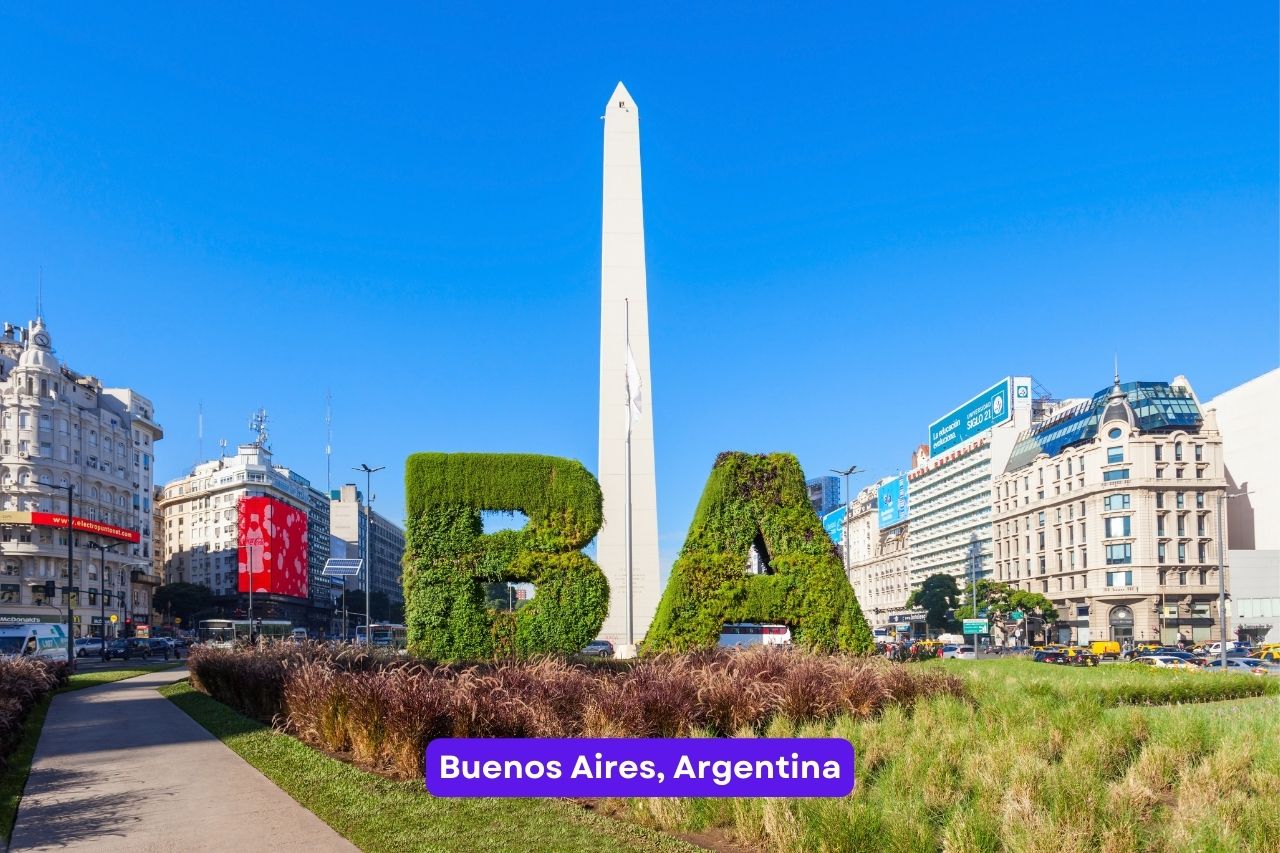
Obelisco
- Address: Av. 9 de Julio s/n, C1043 Buenos Aires, Argentina
- Opening hours: All day
- Entrance fee: Free
A popular sight, El Obelisco is located over the city at a height of 68 meters (223 ft). It was constructed in 1936 to mark the city’s 400th anniversary of founding and to designate the city as both the nation’s capital and the location of the first Argentinean flag to fly. The St. Nicholas de Bari church, which was destroyed to make room for the obelisk, is where the flag was truly flown for the first time in 1812. At the intersection of 9 de Julio Avenue and Corrientes Avenue, it proudly soars upwards into the sky. 9 de Julio Avenue, so named because it commemorates the day in 1816 that Argentina proclaimed its independence from Spain, is reputed to be the largest roadway in the world.
Jardín Japonés
- Address: Av. Casares 3450, C1425EWN C1425EWN, Buenos Aires, Argentina
- Opening hours: 10:00 – 18:30
- Entrance fee: 1,500 pesos
Numerous of the city’s biggest and most well-liked parks are located in Palermo, the primary hangout for Buenos Aires locals, known as Porteños. Originally belonging to the dictator Juan Manuel de Rosas’ estate, the neighborhood now houses a wide variety of excellent ethnic eateries and avant-garde clothing stores.
The city’s top botanic gardens, Jardín Botánico, with its many lakes, bridges, and sculptures dispersed over 20 acres of paradise, are also located here. The gardens, which date back to 1898, have some 5,000 different flower varieties, many of which are native to Argentina.
Highlights include the French and Italian Gardens, a horticulture school, and a museum dedicated to herbs. The largest Japanese garden in South America, the Buenos Aires Japanese Gardens are also well worth a visit. It is well-known for its bonsai collection, exhibits of traditional arts and crafts, and cultural center.
Plaza de Mayo
- Address: Av. Hipólito Yrigoyen s/n, C1087 Buenos Aires, Argentina
- Opening hours: All day
- Entrance fee: Free
Plaza de Mayo is home to magnificent historic colonial structures that evoke the Belle Époque style of Buenos Aire. This charming two-block-long plaza, which dates back to the 16th century, is the nation’s oldest public square and has hosted numerous significant events throughout the city’s history.
Many of the neighborhood’s attractions and activities can be easily combined into an enjoyable walking tour, as the area is now mostly pedestrianized, including the well-known Florida and Lavalle Streets. Plaza de Mayo is hence the ideal starting point for any sightseeing tour of Buenos Aires.
Reserva Ecológica Costanera Sur
- Address: Av. Dr. Tristán Achával Rodríguez 1550, C1768 Buenos Aires, Argentina
- Opening hours: 08:00 – 18:00 (except Monday)
- Entrance fee: Free
The Ecological Reserve, spanning 350 hectares, is the most expansive green area in the City of Buenos Aires and a popular destination for weekend family outings, jogging, walking, cycling, and trekking. An unmatched opportunity to explore the local flora and fauna in the center of the city. This special area, designated a Ramsar site in 2005 because of its significance as a wetland globally, includes forests, grasslands, lagoons, and wetlands.
Jardín Botánico Carlos Thays
- Address: C1425 Vùng đô thị Buenos Aires, Argentina
- Opening hours: 08:00 – 19:00 (Tuesday – Friday) | 09:30 – 19:00 (Saturday – Sunday)
- Entrance fee: Free
French landscape painter Carlos Thays arrived in Buenos Aires at the age of forty and went on to transform the city’s landscape in the late 19th and early 20th century. Several parks were created and others were refurbished while he was in charge. However, the botanic garden was his pet endeavor.
The botanical garden, which is close to the zoo in the Palermo neighborhood, is home to over 5,000 different plant species, some of which are arranged in displays and others not. Past visitors have said that the park is a wonderful place to get away from the bustle of the city, whether they choose to read on a bench or wander along the park’s meandering paths.
El Ateneo Grand Splendid
- Address: Av. Sta. Fe 1860, C1123 Buenos Aires, Argentina
- Opening hours: 09:00 – 21:00 (Monday – Saturday) | 12:00 – 21:00 (Sunday)
- Entrance fee: Free
The British newspaper The Guardian claims that El Ateneo Grand Splendid ranks as the second-best bookstore globally. The former Gran Splendid theater/cinema, created by architects Peró and Torres Armengol, is preserved in all of its grandeur and elegance.
When the location was transformed into a bookstore in 2000, all of the original décor—including the dome, which had murals painted by Italian Nazareno Orlandi—was expertly preserved. About 120,000 books are kept in stock by the store, and also has a coffee shop and bar situated on the theater’s former stage.
The store is filled with comfortable chairs, which makes perusing the books a delightful experience. The upper level is utilized for displays and exhibitions, while the basement is devoted to children’s books.
Teatro Colón
- Address: Tucumán 1171, C1049 Buenos Aires, Argentina
- Opening hours: 10:00 – 16:45 (Monday – Friday) | 11:00 – 16:45 (Saturday – Sunday)
- Entrance fee as follows
| Category | Fee (AR$) |
| Child under 07 years old | Free |
| Student | 3,500 |
| Adult | 18,000 |
The Colón theater, along with La Scala in Milán, the Opera Garnier in Paris, and the Royal Opera House in London, is regarded as one of the greatest opera houses in the world. It is known for its amazing acoustics and breathtaking architecture.
The theater opened in 1908 and hosted some of the most significant conductors, singers, and dancers of the 20th century, including Igor Stravinsky, Herbert von Karajan, Daniel Barenboim, Maria Callas, Luciano Pavarotti, Plácido Domingo, Rudolf Nureyev, Julio Bocca, and Maximiliano Guerra. The theater was designed by Francesco Tamburini, Victor Meano, and Jules Dormal and was constructed over a 20-year period.
The famed Instituto Superior de Arte, where future singers and dancers like Julio Bocca and Maximiliano Guerra once studied, is also housed in the structure along with set and costume workshops.
Museo de Arte Latinoamericano de Buenos Aires
- Address: Av. Pres. Figueroa Alcorta 3415, C1425CLA Buenos Aires, Argentina
- Opening hours: 12:00 – 20:00 (except Tuesday)
- Entrance fee as follows
| Category | Fee (AR$) |
| Child under 05 years old | Free |
| Student | 2,000 |
| Adult | 4,000 |
One of the most fascinating museums in the city is the Museum of Latin American Art (MALBA), which is home to the Costantini Foundation’s art collection, which includes around 400 pieces (paintings, sculptures, engravings, photographs, and objects) by eminent Latin American artists from the 20th century. Covered in limestone and featuring expansive glass and steel surfaces, the modern structure housing the Malba was constructed in 1997 by the Cordoban studio Atelman-Fourcade-Tapia. The studio was the winner of an international competition, with renowned architects Norman Foster, César Pelli, and Mario Botta serving as judges.
Museo Nacional de Bellas Artes
- Address: Av. del Libertador 1473, Buenos Aires, Argentina
- Opening hours: 11:00 – 20:00 (Tuesday – Friday) | 10:00 – 20:00 (Saturday – Sunday)
- Entrance fee: Free
The largest museum in Argentina, Museo Nacional de Belles Artes, is renowned for its extensive collection of over 700 masterpieces from Europe’s 19th century, including works by well-known artists like Manet and Van Gogh. Head to the affluent Recoleta area on Libertador, one of Buenos Aires’ longest avenues, to locate the Museo Nacional de Belles Artes.
Established in 1896, the museum features work of art mainly from Europe during the 19th century and is home to the largest collection of Argentine art in the world. Items from the Middle Ages to the present are included in this collection.
Permanent exhibitions are housed in over 10 rooms across the museum. They have spectacular exhibitions and sculptures that go back to 600 A.D. The museum partners with other museums to present a variety of masterworks in its temporary exhibitions.
Tres de Febrero Park
- Address: Av. Infanta Isabel 110, Buenos Aires, Argentina
- Opening hours: All day
- Entrance fee: Free
One of the most well-liked open places in the city is the enormous Tres de Febrero Park, also referred to as Los bosques de Palermo (The Forests of Palermo). It’s the ideal spot to unwind and go for a stroll, jog, cycle, rollerblade, or picnic with friends.
The park includes the Rosedal de Palermo, a rose garden with over 8,000 roses from 93 different types, a planetarium, and two lakes with pedalos available for rent. The rose garden also features a poets’ garden with busts of several writers, including Buenos Aires native Jorge Luis Borges and Dante Alighieri, as well as an Andalusian patio provided by the Spanish city of Seville in 1929. Among the numerous other sculptures is a marble representation of Little Red Riding Hood that the local government purchased in 1937.
Palacio Barolo
- Address: Av. de Mayo 1370, C1085 Buenos Aires, Argentina
- Opening hours: 10:00 – 22:00 (Monday) | 09:00 – 22:00 (Tuesday – Friday) | 10:00 – 23:00 (Saturday) | 10:00 – 21:00 (Sunday)
- Entrance fee as follows
| Type of tour | Category | Fee (AR$) |
| Day Guided Tour | Child under 07 years old | Free |
| Student/ Retiree | 12.7 | |
| Adult | 16.8 | |
| Evening Guided Tour | Child under 07 years old | Free |
| Student/ Retiree | 17.6 | |
| Adult | 33.7 |
Located in the Monserrat neighborhood, the magnificent Palace Barolo is a prominent office structure that conceals several interesting architectural details. The structure was created by Mario Palanti, an Italian architect, for Luigi Barolo, a businessman. It features several allegorical architectural allusions to Dante Alighieri’s Divine Comedy, which is divided into three sections: heaven, hell, and purgatory. Palenti also included Indian elements into his design; the Rajarani temple in Bhubaneswar and the Hawa Mahal in Jaipur served as inspiration for the building’s dome.
Buenos Aires Metropolitan Cathedral
- Address: San Martín 27, C1004 Buenos Aires, Argentina
- Opening hours: 08:00 – 19:00 (Monday – Friday) | 09:00 – 19:30 (Saturday, Sunday)
- Entrance fee: Free
This fairly plain-looking Catholic church is actually filled with many valuable artworks, including altarpieces and statues from the 18th century, and a stunning Neo-Renaissance and Neo-Baroque interior. Additionally, there’s a magnificent 3,500-pipe Walcker organ from 1871, which is thought to be among the best of its kind. The grave of General José de San Martín, one of Argentina’s most respected revolutionary heroes, is well worth seeing.
Mendoza
Sun-drenched Mendoza, with the Andes Mountains as a backdrop, is well known as Argentina’s wine capital. Visiting the bodegas (wineries) of Mendoza to sample its renowned malbecs is among the top things to do there. But this multicultural city has much more to offer, with quaint cafés and eateries as well as plazas like Plaza Espana that are surrounded by trees and fountains. Adventurers can go fly fishing, skiing, horseback riding, whitewater rafting, or biking through vineyards. Due to its convenient access to Aconcagua Provincial Park, it is also an ideal location for hikers.
Monument to the Army of the Andes
- Address: Cerro de La Gloria, Mendoza, Argentina
- Opening hours: All day
- Entrance fee: Free
Located at the summit of Cerro de la Gloria in General San Martín Park is a monument dedicated to the Army of the Andes. Juan Manuel Ferrari, a sculptor from Uruguay, constructed two models and selected the most significant features from each. To select the location for the monument, Ferrari traveled to the province. “This is my mound,” he shouted upon seeing Cerro del Pilar. Cerro del Pilar became Cerro de la Gloria in 1913, and building got underway.
The sculpture’s components are all composed of bronze and have rich symbolic value. The celebration of the liberator is the monument’s central motif. General San Martín is depicted as an equestrian statue in the composition’s middle, flanked by two groups of Grenadiers. The monument’s three friezes highlight the most noteworthy periods of the army’s development.
Above all of these stands the symbolic figure of Liberty, representing freedom and independence while draped in the national flag and holding up a broken chain. The shields of Chile, Peru, and Argentina are positioned at the base. On February 14, 1914, the 97th anniversary of the Battle of Chacabuco, the monument was officially opened.
Parque General San Martín
- Address: Av Emilio Civit 701, M5500 Mendoza, Argentina
- Opening hours: All day
- Entrance fee: Free
Built in the 1890s in the style of English and French landscaping, Mendoza’s General San Martín Park is an immense area featuring classical statues, decorative fountains, a lake, and a walkway-lined rose garden. In addition to the rose garden, this location attracts hundreds of other plant and tree species, which is why nature enthusiasts come here. Families are also drawn to the park because of its zoo, which is home to creatures like giraffes, elephants, and lions. Enjoy a hike, a bike ride, or a leisurely stroll along the meandering paths, where you will come across numerous sculptures.
Plaza Independencia
- Address: Gral. Espejo 300, M5502 AVJ, Mendoza, Argentina
- Opening hours: All day
- Entrance fee: Free
One of Mendoza’s most exquisite meeting spots is Plaza Independencia, located in a city filled with verdant squares. It was established in 1861 in the wake of the earthquake and spans multiple city blocks, featuring a variety of pines, palms, and flower beds. The tranquil environment is completed with wrought-iron park benches, beautiful lighting, and water fountains. It’s also the ideal spot to unwind, have a bite to eat, and spend a few hours people watching, taking in live music, or perusing the craft vendors. Locals congregate here for live street theater performances, skateboarding, and sunbathing.
Fountain of the Continents
- Address: Mendoza, Mendoza Province, Argentina
- Opening hours: All day
- Entrance fee: Free
Four continents are symbolized by the Fuente de los Continentes: America, Asia, Europe, and Africa. The fountain has the aesthetic qualities common to 17th- and 18th-century European ornamental fountains. The main pool of the fountain is over 20 meters in diameter and boasts four exquisite mermaids clutching seashells. Four atlantes, two male and two female, sit majestic in the middle of the second pool, supporting four enormous plates, each measuring 5.4 meters in diameter.
Four statues of kids holding up the final plate make up the fountain’s third level. Each member of the creative ensemble has been expertly crafted. Their faces have a remarkable level of elegance, and their outstanding anatomical development and cloth movement provide the sense of remarkable expressive force and beauty. The Fuente de los Continentes represents the cohesion and togetherness of all the world’s nations and peoples.
Parque Provincial Aconcagua
- Address: RN7 10, Puente del Inca, Mendoza, Argentina
- Opening hours: 10:00 – 18:00
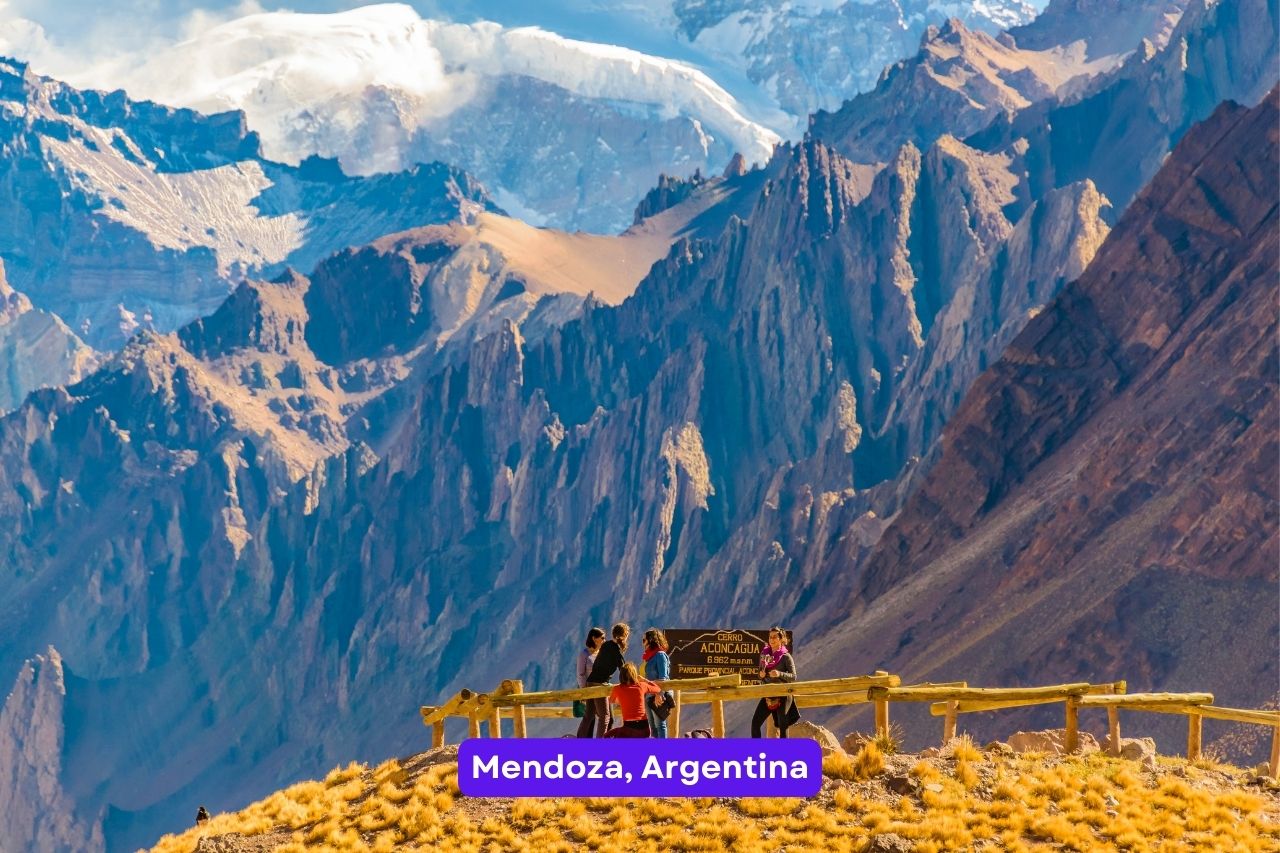
With its majestic peak, Aconcagua Mountain, standing at 22,837 feet (6,961 meters) and ranking among the world’s highest summits outside of the Himalayas, Aconcagua Provincial Park is a hiker’s paradise, offering panoramic vistas of the Andes Mountains as well as secluded valleys, glacial lagoons, and towering peaks.
There are plenty of choices for shorter excursions, but scaling Aconcagua’s peak is a task best left to seasoned climbers. The most striking hike is the 10-mile (16-kilometer) round-trip trek to Confluencia, which takes about six hours total and offers breathtaking views. For children or less energetic travelers, a shorter round to the Horcones Lagoon is a great option.
Ushuaia
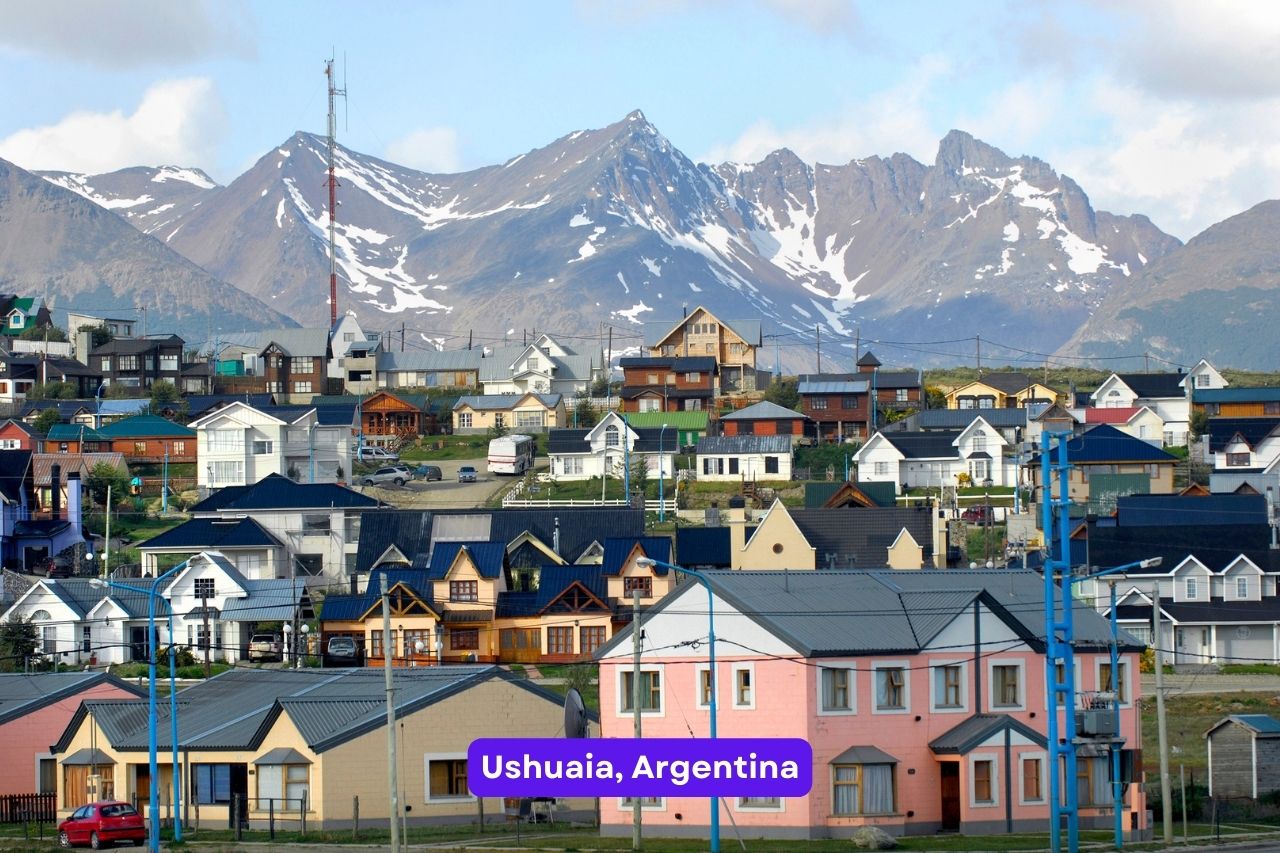
Ushuaia, which is the perfect starting point for explorations of the area known as the End of the World, is situated on Isla Grande at Argentina’s southernmost tip. Nestled between the chilly waters of the Beagle Channel and the southern Andes, Tierra del Fuego’s provincial capital has long been used as a starting point for both land and sea adventures, ranging from cruises to Antarctica to glacier explorations.
Museo Marítimo y del Presidio de Ushuaia
- Address: Gobernador Paz y Yaganes Ex Presidio, V9410 Ushuaia, Tierra del Fuego, Argentina
- Opening hours: 10:00 – 20:00
- Entrance fee as follows
| Category | Fee ($) |
| Child under 12 years old | Free |
| Student up to 24 years old | 15 |
| Adult | 19 |
| Family 02 adults + 03 children under 18 years old | 59 |
The prison colony built on the coast in 1896 is responsible for the creation of the contemporary city of Ushuaia. Now known as the Museo Maritimo, the four museums housed within the prison complex were shut down in 1947. The Prison Museum draws the greatest number of tourists, despite the fact that the Maritime Museum, the Antarctic Museum Jose Maria Sobral, and the Marine Art Museum are all worthwhile explorations. A portion of the original jail has been preserved and is accessible for study, along with details concerning penalties, prison life, and the most well-known inmates of the penitentiary. The feeling of exploring the cold, empty cells is one that will stay with you forever.
Tierra del Fuego National Park
- Address: RN3 kilómetro 3067, V9410 Ushuaia, Tierra del Fuego, Argentina
- Opening hours: 08:00 – 20:00
- Entrance fee as follows
| Category | Fee ($) |
| Child 06-16 years old | 1,500 |
| Student | 1,500 |
| Adult | 12,000 |
One of Ushuaia’s main natural attractions is Tierra del Fuego National Park, which is also the simplest to reach and the only national park with a coastal coast. Along the clearly designated pathways, tourists can witness a variety of natural treasures, including cascading waterfalls, glistening rivers, woodlands, and glacier-capped mountains.
The birds and animals that inhabit this area are equally varied and stunning, ranging from the Patagonian grey fox to the southern sea otters and buff-necked ibis. The park is home to North American beavers, and walks around the area provide up-close looks at the dams these hardworking animals have constructed.
Beagle Channel
Address: Tierra del Fuego Province, Argentina
Within the Tierra del Fuego Archipelago, the Beagle Channel is a strait that divides Isla Grande from a number of smaller islands to the south. The open ocean Drake Passage to the south and the Straits of Magellan to the north are the other two viable routes around South America, with the canal being one of them.
The finest way to see the Beagle Channel is from a boat tour departing from Ushuaia. In addition to offering fantastic views of the mountains bordering the strait, the cruise will highlight sites like the sea lion population at Isla de los Lobos and the penguins on Martillo Island.
Laguna Esmeralda
- Address: Ushuaia, Tierra del Fuego Province, Argentina
- Opening hours: All day
- Entrance fee: Free
The trek to Laguna Esmeralda, which is northeast of Ushuaia, is one of the most well-liked walks in the area. There’s a short but muddy hike through a peat bog to get there, but the views from this hidden lake make the trip worthwhile. The sediments that the glaciers’ gradual movement removed from the rocks give the lake its peculiar hue. Early in the morning, when the sun is shining and everything is sparkling, is the ideal time to see the lagoon.
Museo del Fin del Mundo
- Address: Av. Maipú 173, V9410 Ushuaia, Tierra del Fuego, Argentina
- Opening hours: 10:00 – 19:00 (Monday – Friday) | 13:00 – 19:00 (Saturday)
Explore the Museum of the End of the World (Museo del Fin del Mundo) to commemorate your trip to the southernmost city on Earth. With exhibits of furniture, weapons, and keepsakes from past travelers, the museum highlights the natural and Indigenous heritage of Ushuaia. An informative introduction to the City at the End of the World can be obtained by visiting this museum.
Puerto Iguazu
You’ve come to Puerto Iguazu specifically to get a view of the magnificent Iguazu Falls. Dramatic vistas and wet clothes are guaranteed as you explore one of the greatest waterfalls in the world, whether you cruise beneath Devil’s Throat Falls, take the rainforest train, or cross the border to the Brazilian side of the falls. There are more things to do in Puerto Iguazu besides visiting the UNESCO-listed falls. In addition, you can explore the Guarani people’s culture, go on a trip through the jungle, and see an amethyst mine.
Three Borders Landmark
- Address: Linha Aparecidaa, Itapiranga, Santa Catarina, Argentina
- Opening hours: 08:00 – 18:00
- Entrance fee: Free
Three countries share the famed Iguaçu Falls (also known as Iguazú Falls): Brazil, Argentina, and Paraguay (which only claims the rivers, not the falls themselves). All three countries have built memorials overlooking the area where the Iguaçu and Paraná rivers converge, even though the border itself is not marked there. The Tripartite, or triple-border zone, is denoted by these three obelisks, which were first erected in 1903 and painted patriotically with the colors of their individual flags. Every one of them has a lovely view of the rivers and is encircled by merchants offering refreshments and mementos.
Iguazú Fall
- Address: Misiones Province, Argentina
- Opening hours: All day
- Entrance fee as follows
| Type of ticket | Category | Fee (AR$) |
| General Ticket | Child 06-16 years old | 5,000 |
| Adult | 20,000 | |
| Full Moon Walk | Child up to 05 years old | Free |
| Child 06-12 years old | 20,000 | |
| Adult | 40,000 |
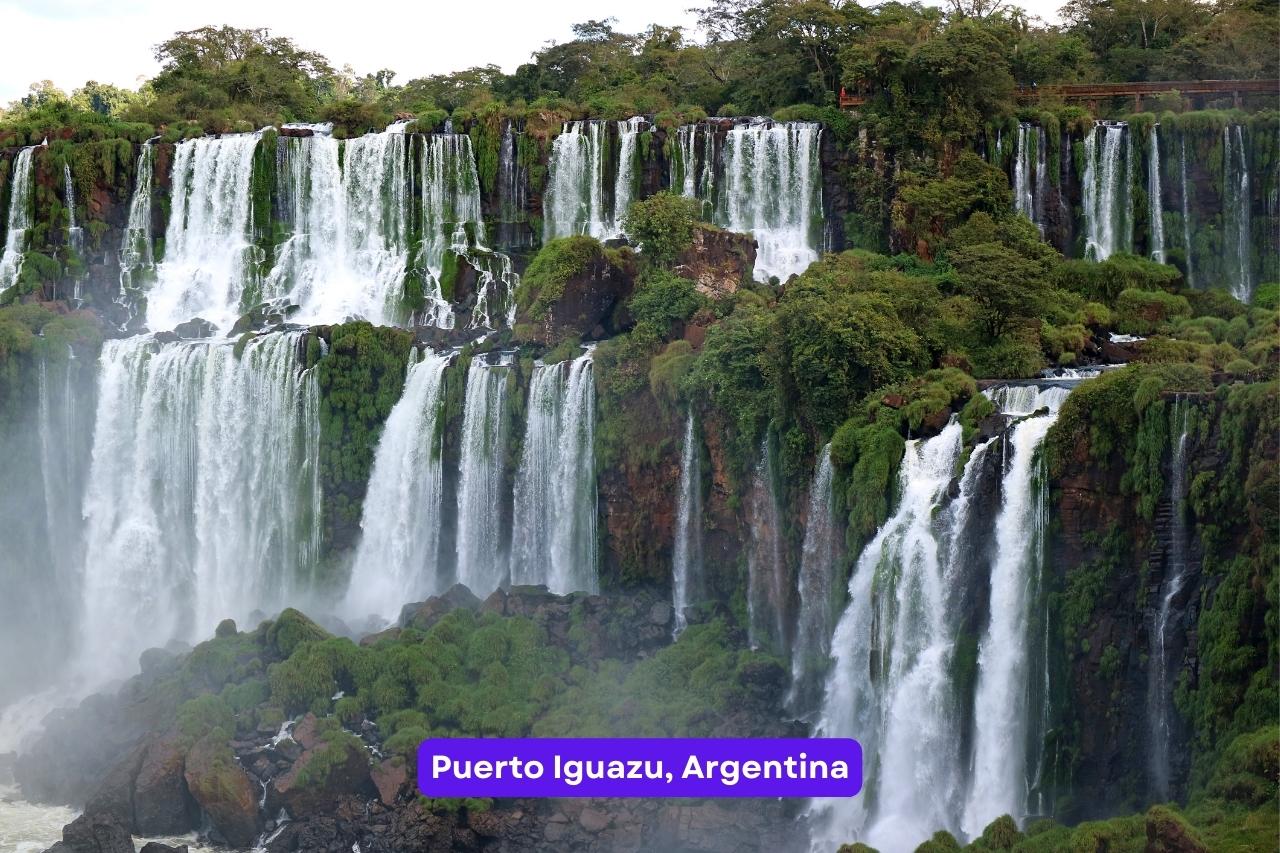
The breathtaking Iguazú Falls, which span the border between Brazil and Argentina, are the largest waterfalls in the world. Approximately 80% of the 275 distinct cascades of this natural wonder are found in Argentina, despite the fact that Brazil offers superior views of the falls. A free train links the main trailheads, and paved pathways and catwalks meander around the falls, sometimes coming within arm’s length of the water.
La Aripuca
- Address: 4 1, RN12 2, Puerto Iguazú, Misiones, Argentina
- Opening hours: 09:00 – 18:00
Just outside of Puerto Iguazú, this little ecological theme park provides insight into the natural environment, history, and customs of the indigenous Guarani people, many of whom still speak their native tongue and coexist peacefully with the environment. The location has an eatery, a juice and ice cream bar, and artisan and produce stores.
An hour-long guided tour of the massive five-story model of an aripuca, a Guarani live trap fashioned from native trees, provides tourists with a brief introduction to Guarani culture. Discover more about this indigenous group’s economy, religion, and administration by touring a recreated thatched-roof hamlet.
Güirá Oga
- Address: RN12 1638, N3370 Puerto Iguazú, Misiones, Argentina
- Opening hours: 09:00 – 16:30
- Entrance fee: AR$ 200/adult & AR$ 150/child
Iguazú Falls is home to about 450 different species of birds, but these days the parks are so crowded you’d be lucky to spot a feather. At Güirá Oga, which translates to “House of the Birds” in Guaraní, there’s another tale. For medical care, birds who were hurt, uprooted by deforestation, or taken from traffickers are brought here. Species that are uncommon in the area are also housed in the spacious cages, such as the stunning red macaw. The refuge is situated midway between Puerto Iguazú and the falls in a forested area.


