
Egypt, one of the most visited nations on the continent, is located in the northeastern part of the continent and is surrounded by the Red and Mediterranean Seas. It is well-known worldwide for its historic monuments and ancient archeological sites, and is home to amazing tourist attractions including the Great Sphinx, the Pyramids at Giza, and the Valley of the Kings.
Cairo
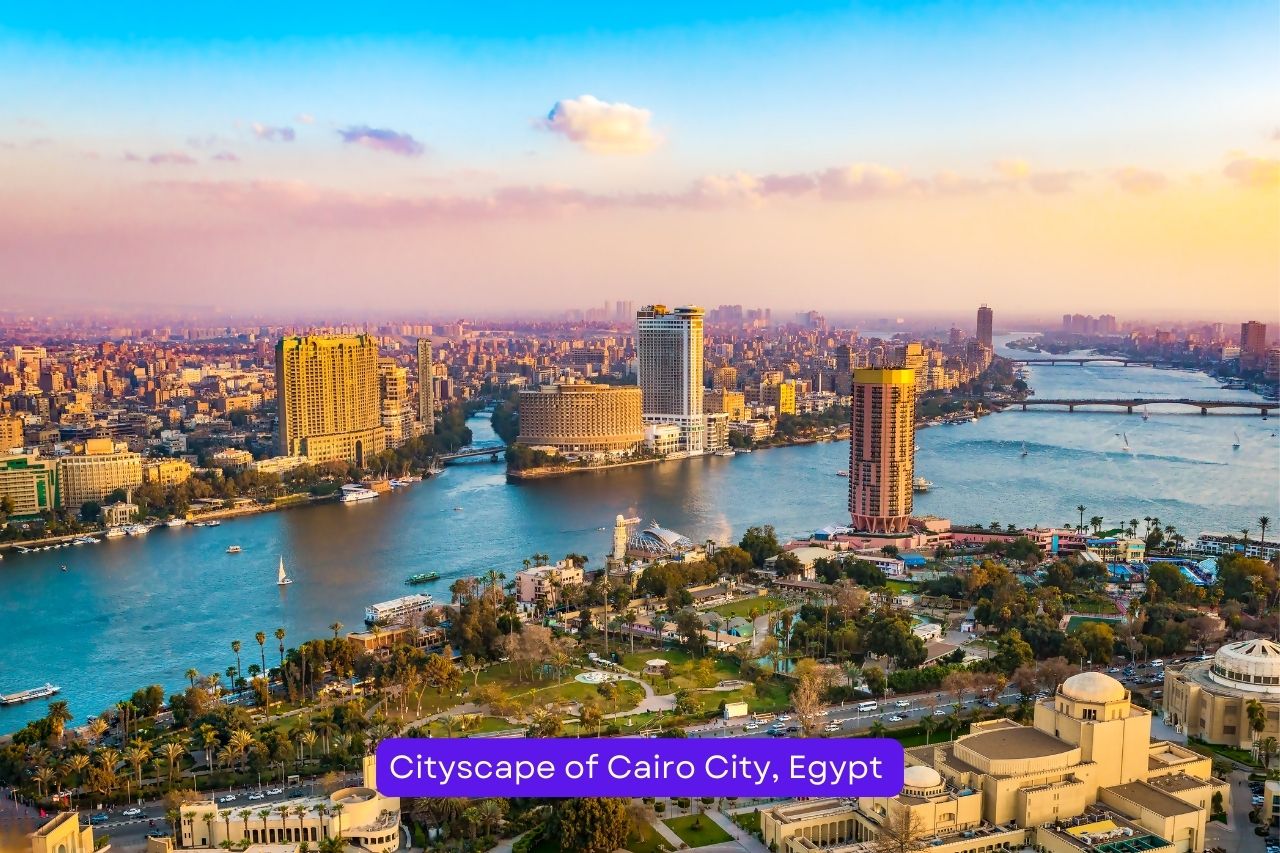
Few places can match Cairo for historical tourism, but the Egyptian capital has much more to offer than simply mosques and museums. Cairo is a city that most tourists adore, despite its beauty and abundance of historical grandeur being unknown to first-time visitors.
Cairo Tower
- Address: Gezira St, Zamalek, Cairo Governorate, Egypt
- Opening hours: 09:00 – 01:00
- Entrance fee: 70 EGP
One of Cairo’s most famous monuments is the Cairo Tower (Burj al-Qahira), which rises to a height of 614 feet (187 meters) on Gezira Island. Constructed in 1961, the tower features an eye-catching lattice façade inspired by a lotus flower, and is topped with a rotating restaurant, an observation deck, and a café. The Cairo Tower is the main attraction for tourists because of its 360-degree panorama. On a clear day, the Giza Pyramids on the outskirts of the city are visible in the distance. Savor a light snack at the café, choose more elaborate food at the restaurant, or stand on the observation deck and watch the sun set.
The Egyptian Museum in Cairo
- Address: El-Tahrir Square, Ismailia, Qasr El Nil, Cairo Governorate, Egypt
- Opening hours: 09:00 – 17:00
- Entrance fee: 300 EGP/adult & 150 EGP/student
The Egyptian Museum (Museum of Egyptian Antiquities), a focal point of Tahrir Square, has been a haven for Egyptologists since it opened and is home to some of the best ancient artifacts in the entire world. The museum is unique in that it displays artifacts from the Pharaonic and Greco-Roman eras, as well as the entirety of Egyptian civilization. Several massive, heavy items, including enormous figures inside the center atrium, are located on the ground floor. Over 100,000 objects were kept in storage by the museum during the height of its collection. However, due to the museum’s cramped and limited location, the majority of the relics were never shown. It is still a must-visit for anybody with an interest in ancient Egypt, even though certain collections are being moved to the new Grand Egyptian Museum.
Al-Azhar Park
- Address: Salah Salem St, El-Darb El-Ahmar, Al-Darb Al-Ahmar, Cairo Governorate, Egypt
- Opening hours: 09:00 – 22:00
- Entrance fee as follows
| Date | Category | Fee (EGP) |
| Sunday – Thursday | Child 02-08 years old | 30 |
| Adult | 40 | |
| Friday & Saturday | Child 02-08 years old | 30 |
| Adult | 45 |
Since its opening in 2005, Al-Azhar Park has offered a much-needed break from the crammed mayhem of Cairo’s streets. The immaculately kept gardens within are a great spot for a stroll in the evening, especially when the sun sets and you can see the entire old city from here. After a tiring day of touring, this location is ideal for relaxing as it offers several dining options.
Khan el-Khalili
- Address: El-Gamaleya, El Gamaliya, Cairo, Egypt
- Opening hours: 09:30 – 00:00
- Entrance fee: Free
Cairo’s most famous shopping destination is the Khan El-Khalili bazaar, which has a history that dates back to the 14th century. The place is a sensory overload of streets, houses, and vendors offering a wide range of goods, including toy camels, shisha pipes, gold, and spices. Of course, there are also the obligatory scarabs, pyramids, and costumes worn by belly dancers. A highlight of every Cairo shopping tour, Khan El-Khalili is a must-see location on excursions of Old Cairo and Islamic Cairo. Take advantage of it with a guide, who can point out the numerous old structures within the souk, assist you in navigating the tight alleys, and offer advice on high-quality purchases.
Al-Azhar Mosque
- Address: El-Darb El-Ahmar, El Gamaliya, Cairo Governorate, Egypt
- Opening hours: 08:00 – 16:00
- Entrance fee: Free
Completed in 972 CE, Al-Azhar Mosque is the most magnificent structure from the Fatimid era in Cairo and one of the oldest mosques still standing. Al-Azhar University is still the preeminent theological hub of the Islamic world even today, having been granted university status by Caliph El-Aziz in 988 CE (the other institution competing for “oldest” distinction is in Fes). It is also among the oldest universities in the world.
The primary entryway is the Gate of the Barbers, which is located next to Abbas II’s neo-Arab facade on the northwest side of the structure. Step out of your shoes at the door and enter the central courtyard. The El-Taibarsiya Medrese, with its mihrab (prayer niche) dating back to 1309, is located to your right. You can see the mosque’s five minarets, which are the highest points of the structure, best from the central courtyard.
The main prayer area is located across the courtyard and occupies an expansive 3,000 square meters. While Abd el-Rahman added the rear half, the front portion of the building is old.
Prince Mohamed Ali Palace
- Address: 1 Al Saraya, Old Cairo, Cairo Governorate, Egypt
- Opening hours: 09:00 – 17:00
- Entrance fee: 100 EGP/adult & 50 EGP/student
The Al Manial neighborhood in Cairo, Egypt is home to the Prince Mohamed Ali Palace, commonly referred to as the Al Manial Palace. Khedive Ismail Pasha’s grandson, Prince Mohamed Ali Tewfik, constructed the palace in the late 1800s.The palace complex, one of the biggest private homes in Cairo, consists of a number of buildings, gardens, and a mosque. The Prince and his family utilized the castle for formal events and celebrations in addition to using it as a summer retreat.
Admire the ornate wood ceilings of the Reception Palace, where guests were hosted, and then move on to the Residential Palace to see its oil paintings, Rococo flourishes, and Ottoman-style tile work. The primary attraction here, though, is the Throne Palace, which is adorned in gold.
Abdeen Palace Museum
- Address: 26VW+7VP, Juma Abdeen Street, El-Gomhoreya Square, Rahbet Abdin, Abdeen, Cairo Governorate, Egypt
- Opening hours: 09:00 – 15:00 (except Friday)
- Entrance fee: 100 EGP
One of Cairo’s most well-known royal residences, Abdeen Palace served as the capital’s seat of administration from 1874 until the 23rd revolution in 1952. After the Revolutionary Command Council made its decision, the palace was designated as one of the presidential palaces. The French architect Rousseau created the Abdeen Palace in Egypt as an example of European architecture that mirrored the European palaces of the day.
Abdeen Palace is spread across two levels. The salamlik and haramlik are on the first floor. The palace’s garden is located on the ground floor, while King Farouq’s office and the former royal printing house are located across from a pharmacy that specializes in uncommon medications.
Additionally, the palace features a number of halls decorated in the colors white, red, and green to welcome official delegations to Egypt. The largest and most opulent chamber in Abdeen Palace is called the Muhammad Ali chamber. It features an inscription inlaid with marble, granite, and amber that is distinctly correct and was constructed in the Arabic-Islamic style. Furthermore, considering its own architectural and ornamental style, the Belgium suite is a spectacular portion of Abdeen Palace. The Belgian king was the first to stay there, which is how it got its name.
Giza
Giza is one of the most popular tourist destinations in Egypt since it is one of the most significant sites to see. The most important monuments of ancient Egypt may be found when you visit Giza. In actuality, even if you are not familiar with pharaonic civilization, you can still clearly recognize the pyramids. Seeing these magnificent buildings up close is an invaluable experience for tourists.
Pyramid of Menkaure
- Address: X4CH+X68, Giza Governorate, Egypt
- Opening hours: 07:00 – 17:00
- Entrance fee: 100 EGP
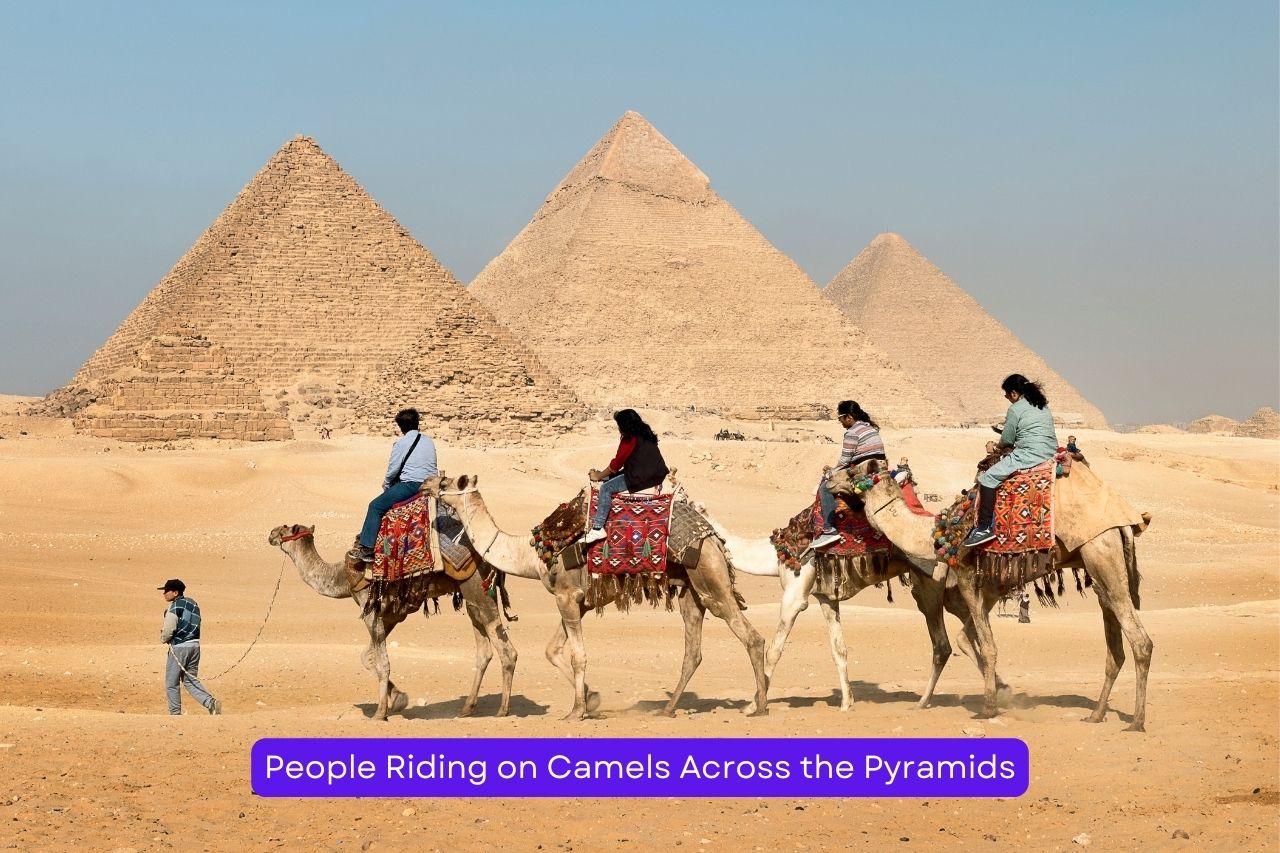
The Pyramid of Menkaure, the smallest of the three main Giza Pyramids, is located on the Giza Plateau, southwest of Egypt’s capital, alongside its two larger equivalents. The Pyramid of Menkaure was constructed in 2,490 BC as the personal burial of Pharaoh Menkaure of the 4th Dynasty. Its original height was 213 feet (65 meters). Built of granite and limestone, its limestone casing was removed, bringing its current height of 204 feet (62 meters) into view. The Great Pyramid of Khufu (Cheops) and the Pyramid of Khafre, which were built separately for Menkaure’s father Khafre and grandfather Khufu, are located to the southwest of it.
Khufu Pyramid
- Address: X4HM+MPC, Al Haram, Nazlet El-Semman, Al Haram, Giza Governorate, Egypt
- Opening hours: 08:00 – 17:00
- Entrance fee: 540 EGP/adult & 270 EGP/student
The Great Pyramid of Giza, sometimes referred to as the Khufu Pyramid or the Pyramid of Cheops in honor of the king who constructed it approximately 2570 BC, is the only surviving wonder of the ancient world. In addition to three lesser pyramids constructed for Khufu’s wives and sisters, the Great Pyramid was ringed by holes used for the interment of Khufu’s solar boat, which is presently on display in a museum. Even though the pyramid has aged and lost its limestone covering, it is still a breathtaking sight. The tallest, largest, and oldest of the three Giza pyramids, it is teeming with dark passageways and accessible to visitors. See the pyramids at night, when they are illuminated with a sound and light performance, for a singular perspective.
Pyramid of Khafre
- Address: X4GJ+97F, Al Haram, Giza Governorate, Egypt
- Opening hours: 07:00 – 15:00
- Entrance fee: 100 EGP
The Pyramid of Khafre, sometimes called the Pyramid of Chephren, is sometimes referred to as the second pyramid. It rises 446 feet (136 meters) above the desert, with the white limestone that formerly adorned all three Giza Pyramids still covering its summit. Because of its elevated location, it appears taller than Khufu’s Great Pyramid at Giza, which was constructed by Khafre’s father.
Highlights include the impressive Khafre mortuary temple, also known as the Valley Temple, as well as a smaller, abandoned pyramid and a walk along an old causeway. There are occasions when tourists can enter the main pyramid’s dim, cramped passageways, but additional tickets are required. Although you can go alone, tour guides can help you avoid pushy sellers, set up camel rides, find the best spots for pictures, and give you background information on the ruins.
Sphinx
- Address: Al Haram, Giza Governorate, Egypt
- Opening hours: 08:00 – 17:00
The entire size of the Sphinx’s body wasn’t visible until 1905, when sand was removed from the monument. The Sphinx, which dates back to Khafre’s reign, narrates the history of Egypt every night in the pyramid sound and light show. The significance, age, and original builder of the 66-foot (20-meter) Sphinx of Giza, a symbol of ancient Egypt, are still up for controversy. One of the biggest and oldest sculptures in the world, the Sphinx, is thought to represent strength, power, and knowledge. It has the body of a lion and the head of a human.
Saqqara
- Address: V698+9PP, Badrshein, Giza Governorate, Egypt
- Opening hours: All day
Saqqara (Sakkara), located roughly 18 miles (30 km) south of Cairo, served as the tomb for Memphis, the now-ruinst ancient Egyptian city. In addition to Pharaoh Djoser, sixteen other rulers also constructed tombs in Saqqara, and the location was used for interment well into the Roman era. The Mastaba of Ti, the Pyramid of Unas, the Pyramid of Sekhemkhet, and the underground Persian Tombs are among the other significant structures on the UNESCO-listed site.
Dahshur
- Address: Dahshur, Badrshein, Giza, Egypt
- Opening hours: 08:00 – 17:00
Dahshur’s arid sands were once home to an amazing 11 enormous pyramids, a sight to behold in contrast to the chaotic surroundings of the Giza Pyramids. Only the Bent Pyramid and the Red Pyramid, constructed by Pharaoh Snefru approximately 4,500 years ago, remain standing today. The top of the Bent Pyramid is curved because cracks developed, causing the architects of Snefru to modify their original design. However, they discovered their error in time to construct Egypt’s first genuine pyramid, the Red Pyramid, which served as a model for Khufu, Snefru’s son, and the Great Pyramid of Giza. Longer Dahshur trips take you into one or more pyramids; shorter tours usually consist of a walk around the pyramids, a photo stop, and maybe a camel ride. Interestingly, visitors can examine both of these structures as well as a smaller side pyramid.
Pyramid of Djoser
- Address: Pyramid of Djoser, Badrshein, Giza Governorate, Egypt
- Opening hours: 08:00 – 17:00
- Entrance fee: 60 EGP
The Pyramid of Djoser, also known as the Step Pyramid, is a must-see when visiting Saqqara. It is thought to be the original pyramid and the oldest stone monument in the world. Seeing the pyramids is a must-do when visiting Egypt. The pyramid of Djoser, the pyramid of Teti, and the tombs of the Old Kingdom aristocracy are all included in most Saqqara trips. Standing tall over Saqqara, surrounded by the ruins of ritual complexes, it was constructed around 2650 BC. The story of the Heb-Sed, a ceremonial race that the ruling pharaoh raced, is occasionally related by guides.
Alexandria
The Great Library of Alexandria and the enormous Pharos Lighthouse, one of the seven wonders of the ancient world, can be found at Alexander, the glittering pearl of the Mediterranean. While there aren’t as many historical sites and activities as in Cairo and Luxor, Alexandria is still one of the best destinations in Egypt to visit if you want to feel the majesty of bygone eras.
Citadel of Qaitbay
- Address: As Sayalah Sharq, Al Gomrok, Alexandria, Egypt
- Opening hours: 09:00 – 20:00
- Entrance fee: 60 EGP/adult & 30 EGP/student
Fort Qaitbey, also known as the Citadel of Qaitbay, is a picturesque sea fort from the 15th century that was constructed on the location of the Lighthouse of Alexandria, one of the oldest and most intact Seven Wonders of the Ancient World. Three pillars probably date from the lighthouse, the modest museum has aquariums and maritime artifacts, and the battlements provide expansive views of the city. A short history of the lighthouse and the fort, a visit to the pillars, a meander around the maze-like chambers within the fortress, which includes the small museum, and an opportunity to take pictures on the battlements are all common features of guided tours.
Montaza Palace Gardens
- Address: Montaza Palace, El-Gaish Rd, Al Mandarah Bahri, Montaza 2, Alexandria Governorate, Egypt
- Opening hours: 08:00 – 00:00
- Entrance fee: 25 EGP
Alexandria’s most exquisite green area, the Montazah Palace Gardens, encircle the privately owned, 19th-century Montazah Palace and go along the waterfront. Highlights include well-kept lawns and flower gardens, as well as an elaborate pink bridge, avenues of palm trees, and beaches.
Bibliotheca Alexandria
- Address: Al Azaritah WA Ash Shatebi, Bab Sharqi, Alexandria Governorate, Egypt
- Opening hours: 10:00 – 19:00 (Sunday – Thursday) | 10:00 – 14:00 (Saturday)
- Entrance fee as follows
| Type of ticket | Category | Fee (EGP) |
| Main Library Ticket | Student | 20 |
| Adult | 150 | |
| An Inclusive Ticket | Student | 120 |
| Adult | 300 | |
| Antiquities Musuem | Student | 50 |
| Adult | 100 | |
| Photography Ticket at the Antiquities Musuem | Mobile Photopraphy | Free |
| Professional Camera – Pictures | 250 | |
| Professional Camera – Videos | 400 | |
| Manuscripts Musuem | Student | 30 |
| Adult | 60 | |
| History of Science Museum | 50 | |
| Planetarium Science Center: Planetarium | 200 | |
| ALEXploratorium | 150 | |
| 12D Theater | 150 |
The greatest and most comprehensive library in the world, Bibliotheca Alexandria, is thought to have had a major impact on the development of Western philosophy. Despite being demolished today, the Alexandrian Library had a profound influence. The Alexandrian Library is home to one of the most impressive book and manuscript collections in the entire world. The library’s collection comprises over 500,000 books, including some of the most valuable and rare manuscripts and books ever produced.
The history, philosophy, and science sections of the library’s collection are especially notable. The library has a substantial amount of Aristotle and Plato’s philosophical treatises in addition to a substantial collection of Herodotus’ historical writings from antiquity. A large selection of books on astronomy, mathematics, and medicine are also available at the library.
Royal Jewelry Musuem
- Address: 27 Ahmed Yehia, San Stefano, El Raml 2, Alexandria Governorate, Egypt
- Opening hours: 09:00 – 16:15
- Entrance fee: 100 EGP
Built in 1923, the palace is an excellent example of the blending of European and Islamic architectural styles. Apart from the ornate, gilded, and frescoed plasterwork ceilings in a few of the rooms, the building’s interiors showcase an assortment of jewelry, household items, and artwork that were once owned by various members of the Muhammad Ali Pasha dynasty.
Serapeum of Alexandria
- Address: Pompey’s Pillar, Al Karah WA at Toubageyah WA Kafr Al Ghates, Karmouz, Alexandria Governorate, Egypt
- Opening hours: 09:00 – 16:30
- Entrance fee: Free
Specifically situated between the Kom al-Shuqafa plateau and the Amud al-Sawari cemetery, the “Temple of the Serapeum” is the most popular tourist destination in Alexandria. That temple had a plain, Greek-style design at first, but once “Ptolemy II” came to power in 284 BC, Egyptian architectural elements started to be added in abundance. All things considered, during his Egypt Classic excursions, the Serapeum of Alexandria is a significant location for those interested in ancient Egyptian religion and culture. It is a very special and fascinating place because of its rich history and cultural significance.
Catacombs of Kom el Shoquafa
- Address: Ras at Tin, Alexandria Governorate, Egypt
- Opening hours: 09:00 – 16:00
- Entrance fee: 35 EGP
One of the most significant historical archaeological sites in the Kom El-Shoqafa neighborhood of Alexandria is the Kom El-Shoqafa Catacombs, which are home to a mixture of Roman, Greek, and Egyptian tombs. This site is regarded as one of the seven wonders of the medieval era. A spiral stairway with a diameter of six meters and a depth of roughly ten meters is used to access the cylindrical water well. This staircase, which leads to a subterranean first floor, was constructed with larger steps at the beginning and smaller ones at the finish in accordance with typical Roman traditions. This is comprised of a hallway that leads to “the Rotunda,” a circular space. Steps at the end of the circular room lead to a second basement that houses most of Kom El Shoqafa’s tombs as well as several halls, hallways, and chambers.
Ancient Roman Theater
- Address: Kom Ad Dakah Gharb, Al Attarin, Alexandria Governorate, Egypt
- Opening hours: 08:00 – 17:00
- Entrance fee: 30 EGP
Alexandria’s Roman amphitheater, the focal point of the Kom al Dikka archeological site, has thirteen levels of white marble seating. Constructed around the 2nd century AD, this 800-seat Roman theater is the only one known to exist in Egypt. It served as a venue for theatrical performances, political protests, and wrestling sessions. In addition to the Roman amphitheater, there are remnants of several classical baths, the Villa of the Birds, which is renowned for its exquisitely maintained mosaics, and what could be an old university in the vicinity.
Alexandria Naval Unknown Soldier Memorial
- Address: Al Gonday Al Maghool Sq., Al Mansheyah Al Kubra, Qesm Al Mansheyah, Alexandria Governorate, Egypt
- Opening hours: All day
- Entrance fee: Free
Alexandria, Egypt’s Manshaya neighborhood is home to the Alexandria Naval Unknown Soldier Memorial. Situated along Alexandria’s Corniche, it is a memorial devoted to the unidentified troops who lost their lives in sea fights. The memorial honors the sacrifices made by these unnamed navy heroes. It serves as a reminder of the heroic actions taken by Egyptian Navy personnel to protect the maritime security of their nation.
Luxor
When it comes to the sheer quantity of historical tourist attractions and things to do for visitors, Luxor surpasses all other towns in Egypt. The town is essentially an outdoor museum due to the abundance of enormous Egyptian temples and tombs with colorful wall murals that are open for visitors.
Luxor Temple
- Address: Luxor City, Luxor, Luxor Governorate, Egypt
- Opening hours: 06:00 – 22:00
- Entrance fee: 180 EGP
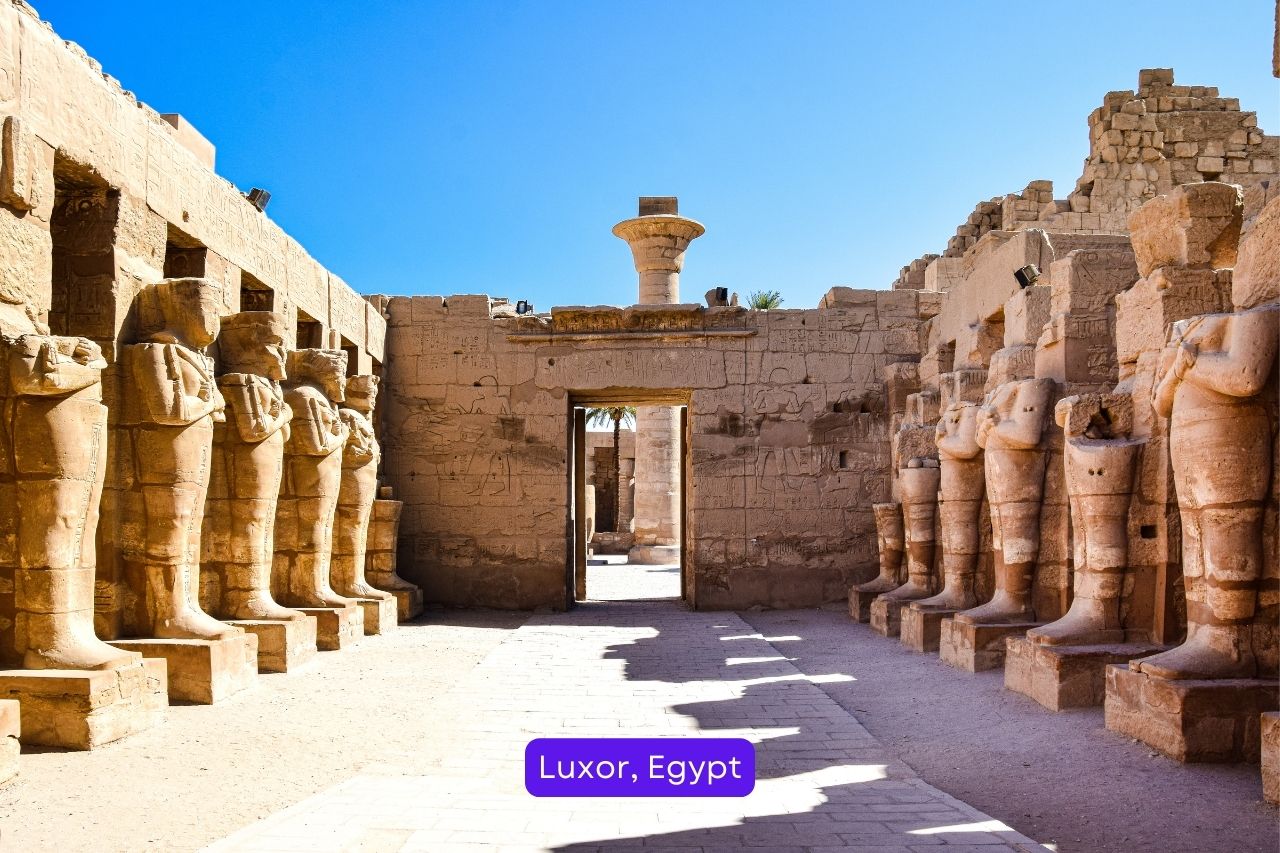
Luxor Temple, which faces the Nile Corniche in the center of the city, is a must-see sight in Luxor. Luxor Temple features towering colonnades, ornate columns, statues, and depictions of Amenhotep III and Ramses II. It is connected to Karnak Temple by the Avenue of Sphinxes. You can see the main temple construction from the outside, but you should go inside to see the displays of ancient history, which include scenarios of royalty being worshipped and images from combat. One of the main attractions on the East Bank of the Nile is the Luxor Temple, which is visited by various guided tours and shore excursions.
Karnak Temple
- Address: Karnak, Luxor, Luxor Governorate, Egypt
- Opening hours: 06:00 – 17:30
- Entrance fee: 450 EGP/adult & 230 EGP/student
This landmark in Luxor, which is close to the city’s traffic, features enormous statues, columns, and the biggest building of worship ever built. Ancient architecture at its most impressive. The extensive artistic and architectural composition of this Egyptian landmark attests to the over a millennium that went into the construction of Karnak Temple. See important locations within Karnak Temple, including the massive Hypostyle Hall, the Sacred Lake, the Temple of Khonsu, and the Ramesses III Chapel. To fully comprehend the significance of what you’re seeing, it’s worthwhile to explore each area with a guide because it’s rich in art and symbolism.
Luxor Museum
- Address: PJ5V+2RV, Kornish Al Nile, Luxor City, Luxor, Luxor Governorate, Egypt
- Opening hours: 09:00 – 14:00 & 17:00 – 20:00
- Entrance fee: 140 EGP
The most important museum in the city and one of the best in the nation, Luxor Museum is located close to popular sites on the East Bank of the Nile. Luxor’s ancient ruins are rendered even more vivid by the antiquities on display, making it an excellent spot to study about the region’s ancient history. The remarkable collection of the Luxor Museum includes some of the most striking items from Thebes, including sandals worn by King Tut and royal mummies. Many relics unearthed from the Valley of the Kings and other Luxor sites can be found here, but the exhibits also cover ancient times up to the Islamic Mamluk period.
Valley of the Kings
- Address: Luxor, Luxor Governorate, Egypt
- Opening hours: 06:00 – 16:00 (Winter) | 06:00 – 17:00 (Summer)
- Entrance fee: 240 EGP
Nestled among several tombs adorned with artwork and hieroglyphics, the Valley of the Kings is a veritable treasure trove of archaeological marvels. See the most well-known landmark in the valley, King Tutankhamun’s tomb, then visit the temples built by Amenhotep III, Ramses II’s sons, and other kings to marvel at the antique artwork and relics dating back millennia.
There are many different experiences to be had from the tombs in the Valley of the Kings, yet just a handful of them are open every day. Although many of the artifacts inside King Tut’s tomb have been taken out and are currently on exhibit in the Egyptian Museum, the tomb itself is full of vibrant, vivid wall murals and houses his linen-wrapped mummy in a glass display case.
Mortuary Temple of Hatshepsut
- Address: Al Qarna, Luxor Governorate, Egypt
- Opening hours: 06:00 – 17:00
- Entrance fee: 160 EGP/adult & 80 EGP/student
A monument to the female pharaoh who ruled ancient Egypt, the Temple of Hatshepsut is set against a stunning backdrop of flaming limestone cliffs. The elegant colonnade of the temple has been rebuilt, and the facade alternates between deep shadows and illuminating columns. Enter to discover sanctuaries, hieroglyphics, and relief carvings. Once you’re there, go through the grand court and up the lengthy slope to a sequence of colonnades and terraces. Since there isn’t much signage inside and some parts of the temple haven’t been rebuilt, going with a guide is a fantastic method to make sense of what you’re seeing.
Colossi of Memnon
- Address: Al Qarna, Luxor Governorate, Egypt
- Opening hours: 06:00 – 17:00
- Entrance fee: Free
The Colossi of Memnon, two enormous statues of the New Kingdom pharaoh Amenhotep III, are 59 feet (18 meters) tall and provide the ideal preface to Luxor’s West Bank’s magnificence. They formerly guarded the entrance to a burial temple that archaeologists are still excavating today. Each weighs about 1,100 tons (1,000 tonnes). Once standing watch at the entrance to the king’s temple, of which only ruins remain, they depict Amenophis III seated on a cube-shaped throne and are carved out of strong yellowish-brown sandstone quarried in the hills near Edfu.
Compared to the north, the south colossus has been preserved better. Its base is mostly hidden by the sand, and it is 19.59 meters tall. Its overall height, including the crown it once wore but has long since lost, had to have been about 21 meters. The renowned “musical statue,” the North Colossus, drew throngs of tourists to this location throughout the Roman Empire.
Aswan
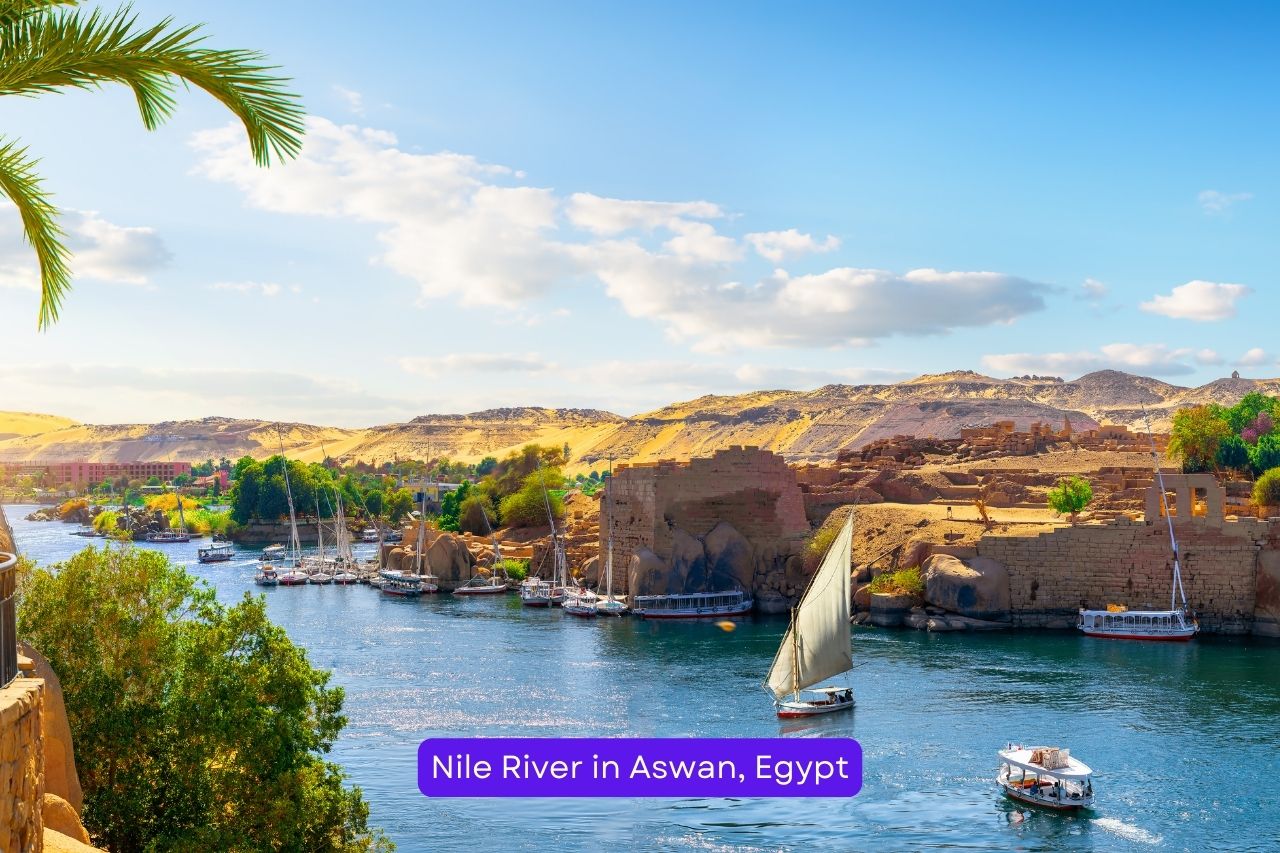
Aswan, which is dispersed along the banks of the Nile, is a laid-back and amiable town that offers a peaceful diversion from the busy Luxor or Cairo. This is the greatest site to go and base yourself for seeing the temples, monuments, and other tourist attractions in the southern regions of Upper Egypt as well as the region’s distinctively unique Nubian culture. Historically, this place served as ancient Egypt’s entrance to Africa.
Nubian Musuem
- Address: Assuan, Sheyakhah Oula, Aswan 1, Aswan Governorate, Egypt
- Opening hours: 09:00 – 17:00
- Entrance fee: 20 EGP
One of Egypt’s best, the Nubian Museum in Aswan is a must-visit for anybody interested in the history and culture of ancient and contemporary Nubia. It captures the splendor of a civilization that was virtually destroyed when Lake Nasser and the Aswan Dam were constructed.
There’s a good selection of artefacts from the ancient Kingdom of Kush (Nubia) and lots of amazing black-and-white pictures of UNESCO’s amazing project to save Abu Simbel and Philae Temple from the rising waters of the dam (plus a ton of pictures of the vast array of other monuments that are forever lost beneath the waters of the lake).
The black granite head of Tahraqa, the head of the Shpatka, a statue of Amenras, and a statue of Ramses II are among the items in the museum collection. The ethnographic part features stunning Nubian handicrafts and folk art in addition to providing a comprehensive explanation of the history of Nubia and its people.
Unfinished Obelisk
- Address: Sheyakhah Oula, Aswan, Aswan Governorate, Egypt
- Opening hours: 07:00 – 16:00
- Entrance fee: 80 EGP/adult & 50 EGP/student
The renowned Unfinished Obelisk, a 41-meter-long and 4-meter-wide piece of stone that was likely abandoned due to a rock break, is located in Aswan’s Northern Quarry. The obelisk would have been the largest ever hewn if it had been finished, weighing an estimated 1,168 tons. The numerous remnants of the labor of prehistoric stonecutters can also be seen on the nearby rock faces. In order to separate the blocks from the rock, a predetermined line would have been bored, wedges would have been driven into the holes, and the wedges would have been submerged in water to release the block.
Aswan Botanical Garden
- Address: 3VVP+FQW, Sheyakhah Oula, Aswan, Aswan Governorate, Egypt
- Opening hours: 08:00 – 17:00
- Entrance fee: 50 EGP
Frequently featured in felucca tours for viewing, the Aswan Botanical Gardens span a little six-hectare island, commonly known as Kitchener’s Island, situated to the west of Elephantine Island. Once owned by Lord Kitchener, the island was turned into a lush garden filled with exotic flora from both Asia and Africa. With lots of chances to see birds in the late afternoon, it’s a nice place to take a leisurely stroll between mature trees and rich vegetation.
Edfu Temple
- Address: Adfo, Edfo, Aswan Governorate, Egypt
- Opening hours: 07:00 – 17:00
- Entrance fee: 60 EGP
Constructed between 237 and 57 BC under the Ptolemaic Kingdom, the Temple of Horus at Edfu is widely considered the best preserved of all the ancient Egyptian temples. The building was preserved to virtually excellent condition for 200 years when it was submerged in about 40 feet (12 meters) of desert sand and Nile silt!
With its extensive wall carvings, the largest temple devoted to Horus—one of Egypt’s most significant historical deities—has provided historians with invaluable information about the Hellenistic period of Egyptian history. The exquisite reliefs shed light on the religion, mythology, and way of life of the time. Statues of the falcon-headed god can be found throughout the complex.
Kom Ombo Temple
- Address: Nagoa Ash Shatb, Markaz Kom Ombo, Aswan Governorate, Egypt
- Opening hours: 07:00 – 21:00
- Entrance fee: 80 EGP/adult & 40 EGP/student
The most well-known stretch of the Nile is the portion that flows north from Aswan to Luxor, where pharaonic temples are strewn along the banks of the river amid palm trees. The Temple of Kom Ombo, located 47 kilometers north of Aswan, is the closest temple along the Nile. Constructed in the Ptolemaic period, the Temple of Kom Ombo is renowned for its stunning internal stone relief work and exceptional preservation due to its relatively young age.


