
Portugal is a popular destination for travelers all year round due to its moderate temperature in all four seasons, which is complemented by a wide range of cultural attractions, untamed mountains, striking coastline, and small, charming cities. Portugal’s cities have a long history connected to the waterways surrounding them, as they are located on the Iberian Peninsula’s western coast and gaze out over the Atlantic Ocean. Notable seafarers sailed from its ports, returning with incredible wealth that contributed to the creation of the magnificent cities we know today.
Lisbon
Lisbon, Portugal’s capital, is a lively city with a unique blend of colorful and whitewashed architecture. Explore the winding, cobblestone alleyways, as well as the Lisbon Cathedral and Sao Jorge Castle, two important cultural sites. The Time Out Market is one location where you may enjoy the local cuisine, which heavily features seafood. This west Portuguese city has a vibrant nightlife as well as several of rooftop bars where you can have a white port and tonic while taking in the scenery.
Praça do Comércio
- Address: 1100-148 Lisbon, Portugal
- Opening hours: All day
- Entrance fee: Free
Lisbon’s Royal Palace stood on Commerce Square (Praça do Comércio) until an earthquake in 1755 destroyed it. The palace has since been relocated, and the area has been embellished with elaborate arches, imposing municipal structures, and a monument of King Jose I on horseback. From Praça do Comércio, marble stairs descend to the Tagus River. Make the most of your stay in Lisbon by taking one of the many sightseeing tours offered by the city, most of which include a visit to the Alfama historic neighborhood, Lisbon Cathedral (Sé de Lisboa), and Praça do Comércio.
Belém Tower
- Address: Av. Brasília, 1400-038 Lisboa, Portugal
- Opening hours: 10:00 – 17:30 (except Monday)
- Belem Tower Entrance fee: €6/adult & free for child up to 12 years old
Situated on the banks of the Tagus River, Belem Tower is a formidable medieval castle that is a popular tourist destination in Lisbon. Known as a UNESCO World Heritage Site, it shares an enduring icon of Portugal’s maritime tradition from the early 16th century with the neighboring Jeronimos Monastery (Mosteiro dos Jeronimos). Viewers can go to the top of the tower and see it from the shoreline stairs or from the bulwark terrace. They can also glimpse into the Governor’s and King’s rooms.
Castelo de Sao Jorge
- Address: R. de Santa Cruz do Castelo, 1100-129 Lisboa, Portugal
- Opening hours: 09:00 – 18:00
- Entrance fee as follows
| Category | Fee (€) |
| Child under 13 years old | Free |
| Young 13-25 years old | 7.5 |
| Adult | 15 |
| Senior from 65 years old | 12.5 |
The highest point in Lisbon has long been occupied by strongholds; numerous castle relics here are attributed to the Romans, Visigoths, Moors, and Portuguese. The remnants of these invaders can still be seen today as you wander about the castle grounds, take in the turbulent past of the citadel, and view the latest finds at the modest archaeological museum within the complex.
Oceanário de Lisboa
- Address: Esplanada Dom Carlos I s/nº, 1990-005 Lisboa, Portugal
- Opening hours: 10:00 – 19:00
- Entrance fee as follows
| Category | Fee (€) |
| Child 0-2 years old | Free |
| Child 03-12 years old | 15 |
| Young & Adult 13-64 years old | 25 |
| Senior from 65 years old | 17 |
A trip to the Oceanarium, created by American architect Peter Chermayeff, constantly tests our understanding on all fronts. The Oceanarium provides guests with a singular and captivating experience. It is home to 15,000 creatures and plants representing over 450 different species, housed in 30 tanks with over 7,000 m3 of saltwater, and that recreate a variety of ocean habitats.
Padrão dos Descobrimentos
- Address: Av. Brasília, 1400-038 Lisboa, Portugal
- Opening hours: 10:00 – 19:00
- Entrance fee as follows
| Type of ticket | Category | Fee (€) |
| Exhibition Ticket | Child under 12 years old | Free |
| Young 13-25 years old | 2.5 | |
| Adult | 5 | |
| Senior over 65 years old | 4.3 | |
| Exhibition, Viewpoint and Film Ticket | Child under 12 years old | Free |
| Young 13-25 years old | 5 | |
| Adult | 10 | |
| Senior over 65 years old | 8.5 |
The Monument to the Discoveries, a spectacular landmark of Lisbon’s seafront, offers some of the greatest photo ops in the city. Take the elevator or ascend over 260 steps to reach the rooftop observation point, which provides a view over the Belem neighborhood and the Tagus River. See the monument’s huge limestone compass mosaic, which demonstrates the extent of Portugal’s adventurers’ travels in the 15th and 16th centuries.
Jerónimos Monastery
- Address: Praça do Império 1400-206 Lisboa, Portugal
- Opening hours: 09:30 – 18:00
- Jeronimos Monastery Entrance fee as follows
| Type of ticket | Category | Fee (€) |
| Jerónimos Monastery | Child under 12 years old | Free |
| Adult | 12.5 | |
| Jerónimos Monastery with Audio Guide | 21 |
Justifiably one of Lisbon’s most notable sights is the Monastery of St. Jerome, often known as Jeronimos Monastery. The 16th-century monastery, a gem in the tourist-heavy Belem neighborhood, is nonetheless a potent reminder of Portugal’s richness and strength during the Age of Discovery. Here lies Vasco da Gama’s everlasting resting place, surrounded by imposing columns, a striking stone roof, and magnificent Manueline cloisters.
Lisbon Cathedral
- Address: Largo da Sé 1, 1100-585 Lisboa, Portugal
- Opening hours: 10:00 – 18:00 (except Sunday)
- Lisbon Cathedral Entrance fee as follows
| Category | Fee (€) |
| Child up to 06 years old | Free |
| Child 07-12 years old | 3 |
| Adult | 5 |
Sé de Lisboa, or the Lisbon Cathedral, is the city’s oldest and most significant cathedral. The majority of its construction, which took place in the 12th century, is Romanesque in style. Although the Lisbon Cathedral is primarily Romanesque in architecture and has an austere aspect, over time it has undergone skilled changes that have given it a unique character.
The cathedral has a look more akin to a medieval stronghold than a church because of its massive walls, which are framed by two bell towers. The central rose window on the façade serves as its focal point, and it still has the Romanesque design of the twelfth century.
Once inside, the temple includes several ornamental features among its austere exterior, such the baptismal font of Saint Anthony of Padua, a few sarcophagi from the 14th century, and a beautiful Gothic chapel from the same era.
Carmo Convent
- Address: Largo do Carmo 27, 1200-092 Lisboa, Portugal
- Opening hours: 10:00 – 18:00 (except Sunday)
- Carmo Convent Entrance fee as follows
| Category | Fee (€) |
| Child up to 14 years old | Free |
| Adult | 5 |
| Senior | 4 |
Even though the dilapidated Carmo Convent hasn’t had a roof since it collapsed during the 1755 earthquake, it is regarded as Lisbon’s most beautiful church. It currently serves as both a monument and a reminder of the earthquake. The stunning medieval arches are still intact and well worth seeing. The 16th and 18th centuries saw the addition of Manueline (Portuguese Gothic) windows and other features, but the construction itself dated mostly to the 1300s. If you look hard, you can even make out two very spooky South American mummies—a young Peruvian girl and a boy.
Calouste Gullbenkian Museum
- Address: Av. de Berna 45A, 1067-001 Lisboa, Portugal
- Opening hours: 10:00 – 18:00 (except Tuesday)
- Entrance fee as follows
| Category | Fee (€) |
| Child under 12 years old | 12 |
| Adult under 30 years old | 7.5 |
| Adult 30 – 65 years old | 10 |
| Senior over 65 years old | 9 |
The Museum is one of the most well-known in Portugal because to the Calouste Sarkis Gulbenkian Collection, one of the most significant private collections in the world. Take a 5000-year art trip and see masterpieces from the 20th century to Ancient Egypt. The collection’s artworks are a reflection of the high caliber of craftsmanship and sophisticated aesthetic sensibility that went into their purchase. With the help of the most esteemed experts, Calouste Gulbenkian was able to choose the best, resulting in a singular collection of pieces that add to the Museum’s distinctive experience.
National Tile Museum
- Address: R. Me. Deus 4, 1900-312 Lisboa, Portugal
- Opening hours: 10:00 – 18:00 (except Monday)
- National Tile Museum Entrance fee: €5
The National Tile Museum is located in the somewhat remote, 16th-century Convent of Madre de Deus, which is only accessible via taxi. The museum is unique in the entire globe, which makes it worthwhile to see. The Portuguese have created a specific kind of art that consists of paintings on ceramic tiles that are notable for their heavy use of blue colors to depict various settings.
Travelers who are interested in learning more about this kind of art—which is worth exploring considering how rare it is—should visit the National Tile Museum to view a piece that is 53 meters long and made up of over 1,300 tiles. The 1738 version of Lisbon is depicted in the piece, along with its pre-quake 1755 appearance. This museum, which features more tile works, is one of the tourist attractions in Lisbon that some visitors believe should not be missed.
Porto
Porto is a charming city with brightly colored buildings that overlook the Douro River. The city is dotted with the well-known white and blue tiles that are so closely linked to the nation. Porto’s many hills are lined with historic palaces, cathedrals, churches, and other structures. Merely exploring the city is a pleasure in and of itself. See the river vistas, winding, small lanes, and vibrant ambiance of Ribeira’s historic center.
Luis I Bridge
- Address: Ponte Luís I, Porto, Portugal
- Opening hours: All day
- Entrance fee: Free
Both residents and tourists are enthralled by Porto’s renowned Dom Luis I Bridge. This architectural marvel, which spans the magnificent Douro River, is not only an essential transit connection but also a well-known icon in Porto. The Dom Luís I Bridge is a stunning example of both technical genius and artistic grace. Its double-decked iron construction was designed by Gustave Eiffel’s pupil Théophile Seyrig. This building exhibits an amazing union of style and utility. Pedestrians are catered to on the top deck, which provides a spot for them to take in the scenery. Cars and buses can be accommodated on the lower level.
Porto Cathedral
- Address: Terreiro da Sé, 4050-573 Porto, Portugal
- Opening hours: 09:00 – 17:30
- Entrance fee: Free
The most significant religious structure in the city is the Porto Cathedral, or Se do Porto in Portuguese, which has been designated as a National Monument. Situated in close proximity to the city’s former defenses, the Cathedral is located in Batalha. From the outside, the structure resembles a fortress with crenels. The Cathedral was first erected in the twelfth century, but over the ages, it underwent several reconstructions and renovations. This explains the heterogeneous architectural style of the Cathedral. While the façade and nave of the temple are Romanesque, the cloister and one of the chapels are Gothic, the temple is mostly Baroque in design.
Jardins do Palácio de Cristal
- Address: R. de Dom Manuel II, 4050-346 Porto, Portugal
- Opening hours: 08:00 – 19:00
- Entrance fee: Free
One of Porto’s most attractive green places is the Jardins do Palácio de Cristal, a stunning park that dates back to the end of the 19th century. Located in the upper region of Porto, the Palácio de Cristal Gardens are a delightful green area that offers a unique perspective of the entrance of the Douro River into the Atlantic Ocean. You may explore many themed sections inside the gardens, including the fragrant plant garden, medicinal plant garden, sentiments garden, rose garden, and woodland.
Torre dos Clérigos
- Address: R. de São Filipe de Nery, 4050-546 Porto, Portugal
- Opening hours: 09:00 – 19:00
- Entrance fee as follows
| Type of ticket | Category | Fee (€) |
| Tower + Clérigos Museum | Child up to 10 years old | Free |
| Adult | 8 | |
| Clérigos Museum + Church + Tower Guided Tour | 9.5 | |
| Torre – Night Pass | 5 |
The Clerics Church, created by Italian architect Nicolau Nasoni in the mid-1800s, is a true example of Baroque architecture. Nasoni is known for creating many of the monuments in Porto and the northern area of Portugal.
It is worthwhile to examine the intricate baroque design that covers the whole temple façade. The interior’s granite and marble, covered in ornate carved wood with gold leaf, showcases the architect’s skill as well. We shall see a polychrome altarpiece by Manuel Porto in the main church.
However, the tower made of granite stone that is perched atop the church’s western peak is the ensemble’s most prominent feature. Standing at a height of 75 meters, the Tower is the sole ex-libris in the city. Its thin shape evolves into rhythmic sides that culminate in a stunning baroque embellishment. One of the most breathtaking views of Porto can be seen from the peak, which is reached by an interior staircase consisting of 225 steps.
Evora
Evora is a captivating place to explore, with over 4,000 ancient structures, temples, and churches—some of which date back to Roman times—and more than 2,000 years of history condensed into this little city. There are several interesting sites to see in the city center, including Almendres Cromlech, an amazing megalithic structure outside of Evora, contains a vast group of menhirs and enormous stones arranged in a circle.
Templo Romano Évora
- Address: Largo do Conde de Vila Flor, 7000-863 Évora, Portugal
- Opening hours: All day
- Entrance fee: Free
One of the largest and best-preserved Roman temples on the Iberian Peninsula is the one at Evora. For this reason, UNESCO designated it as World Heritage in 1986. It feels like a trip back in time to look at this Roman temple, which is also mistakenly called Diana Temple. It is perhaps the most well-known and significant landmark in Evora, serving as one of the most obvious reminders of the Roman occupancy of the city.
Constructed in the early 1st century AD in the Corinthian style, it is situated in the historical center, namely in Largo Conde de Vila Flor, close to the Pousada Convento de Evora, Evora Cathedral, Evora Library, Fórum Eugénio de Almeida, and Evora Museum. This will be a very fascinating circuit to do in a single day while you are in Evora. We also recommend taking a trip around Diana Garden, or Jardim de Diana, to unwind, have a cool beverage, and celebrate the breathtaking view of the city and the surrounding Alentejo region.
Chapel of Bones
- Address: Praça 1º de Maio 4, 7000-650 Évora, Portugal
- Opening hours: 09:00 – 17:00
- Entrance fee as follows
| Category | Fee (€) |
| Child under 12 years old | Free |
| Young up to 25 years old | 4 |
| Adult | 6 |
| Senior over 65 years old | 4 |
| Family 02 adults + young people | 15 |
The chapel of Saint Francis is home to Portugal’s most gory tourist destination, the gruesome Capela dos Ossos (Chapel of Bones). The 5,000 monks’ bones that line the Bone Chapel were supposedly exhumed from nearby cemeteries. The 16th-century oratory is covered in hundreds of skulls and shattered corpses. Strangely, two aged bodies—one of which is a child—hang whole from a chain close to the altar. Glancing up, you’ll notice similarly gory pictures painted on the ceiling. The sardonic reminder that says, “Nós ossos que aqui estamos, pelos vossos esperamos,” is posted across the entryway, but it doesn’t seem to bother anybody.
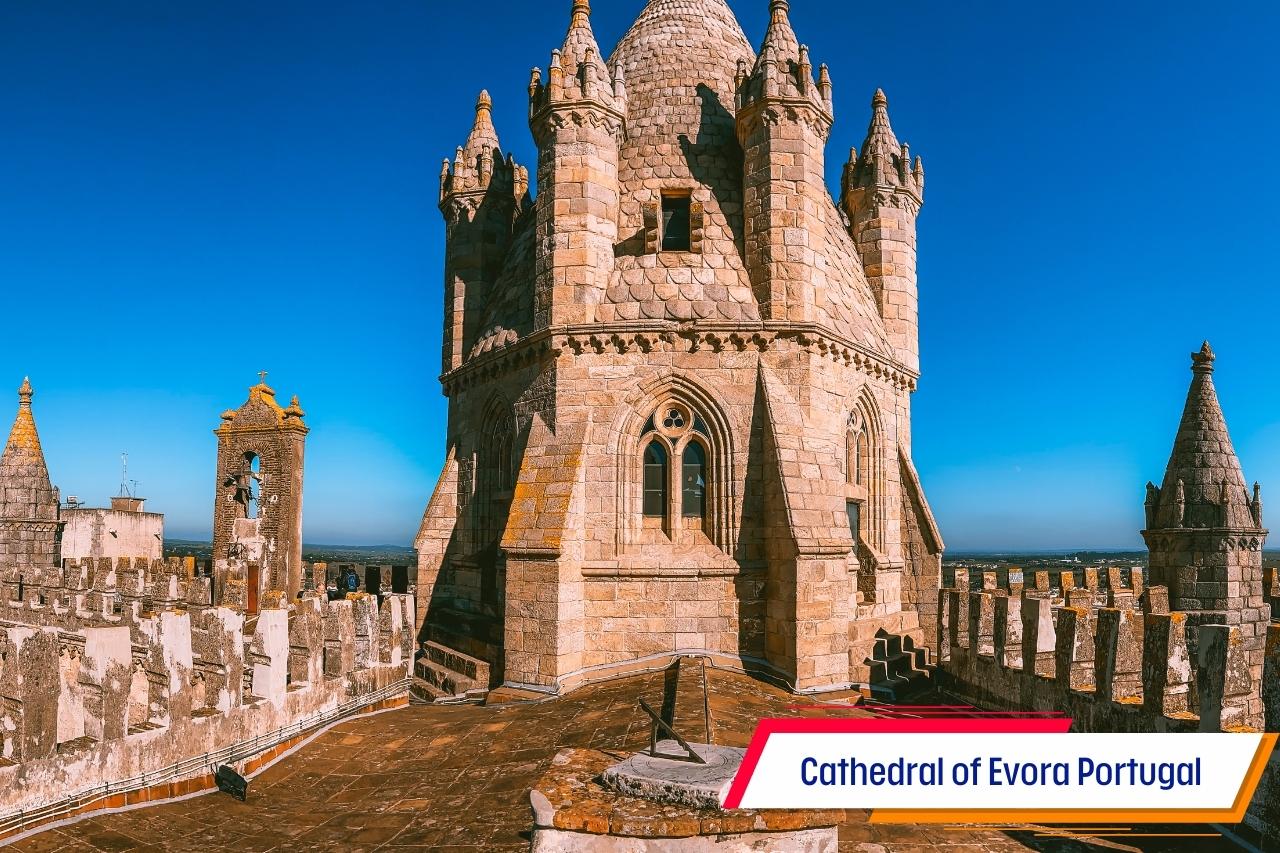
Cathedral of Évora
- Address: Largo do Marquês de Marialva, 7000-809 Évora, Portugal
- Opening hours: 09:00 – 17:00
- Entrance fee: €5 (See + Cloister + Panoramic View + Museum) | €4 (See + Cloister + Panoramic View)
Évora’s cathedral resembles a fortress, much like those in Lisbon, Porto, Coimbra, and many other Portuguese cities. The largest mediaeval cathedral in the nation is called Basilica Cathedral of Our Lady of Assumption. The façade is composed of two towers and an amazing marble gateway adorned with depictions of the Twelve Apostles; the interior has a blend of gothic and baroque styles.
The medieval arches that comprise the cloisters may be seen when ascending to the rooftop, which offers views over Évora and the surrounding countryside. It’s worth climbing the 135 steps on a small spiral staircase in a bell tower to reach the roof. One of the two bell towers has a blue spire, making it unique.
Visits to the church’s affiliated Sacred Art Museum are available separately. The focal point is a French-made ivory Virgin from the 14th century, whose body unfolds to show nine engraved scenes from her life. Although the museum only opened in 2009, the collection—which also included sculptures and paintings—was previously on show in the cathedral’s treasury.
Igreja de São João Evangelista
- Address: Palácio Cadaval, 7000-845 Évora, Portugal
- Opening hours: 10:00 – 13:00 & 14:00 – 18:00 (except Monday)
- Entrance fee: Free
The modest box-like facade of the church of St. John the Evangelist belies its eye-popping interior, a floor-to-ceiling starburst of spectacular early 18th-century azulejo (tile) panels, which portray episodes from the life of São Lourenço. Even those who are not religious will pause to appreciate this superb painting by António de Oliveira. But the 15th-century chapel has a macabre side attraction: an ossuary filled with bones from nearby tombs. As you make your way toward the nave, keep an eye out for the building’s peculiar feature: the Moorish cistern concealed behind a trapdoor positioned amidst the seats. Ask the custodian to open the lid on this fascinating oddity if it’s locked.
Giraldo Square
- Address: Praça do Giraldo 7, 7000-661 Évora, Portugal
- Opening hours: All day
- Entrance fee: Free
An iconic site, Giraldo Square honors the valiant Geraldo Geraldes, who drove the Moors out of Evora in 1167. In appreciation, the first Portuguese monarch, Afonso Henriques, named him Governor of Evora (alcaide of Evora) and High Protector of the Borders of Alentejo, an area he would aid in conquering.
Geraldo Geraldes is depicted on the Evora coat of arms, riding a horse and brandishing a sword. The chiefs of the moor and his daughter, who resided in the castle that the warrior had stormed and where he had taken possession of the city keys, were at his feet. The assets, which included statues and a triumphal arch, were ordered to be demolished once the Portuguese Crown acquired control of Evora in order to construct the fountain, which is still the focal point of attraction for both locals and visitors to Giraldo Square.
Coimbra
With one of the oldest colleges in the world and a wealth of historical structures to astonish history buffs, Coimbra, the main city in the area bearing its name, has long been a center of study. With its serene gardens and historic cathedrals offering views of the Rio Mondego below, the city center is a wonderful place to explore.
Portugal dos Pequenitos
- Address: Largo Rossio de Santa Clara, 3040-256 Coimbra, Portugal
- Opening hours: 10:00 – 17:00
- Entrance fee as follows
| Category | Fee (€) |
| Child under 03 years old | Free |
| Child 03-13 years old | 9.95 |
| Young & Adult 14-64 years old | 14.95 |
| Senior over 65 years old | 11.95 |
| Family 02 adults + 02 children up to 13 years old | 39.95 |
| Family 02 adults + 03 children up to 13 years old | 45.95 |
Though primarily designed with children in mind, adults will also enjoy exploring this Lilliputian terrain at this park that teaches via play. Three museums with exhibits on furniture, traditional clothing, and naval items are located on the grounds. This creative theme park, whose name translates as “the little ones of Portugal,” welcomes adults. This is due to the fact that everything is little and a highly entertaining display of shrunken replicas of some of Portugal’s most treasured national treasures, best buildings, and medieval communities.
Santa Cruz Church
- Address: Praça 8 de Maio, 3001-300 Coimbra, Portugal
- Opening hours: 09:30 – 16:30 (Monday – Saturday) | 14:00 – 17:00 (Sunday)
- Santa Cruz Monastery Entrance fee: €4
Santa Cruz Monastery, also known as the Monastery of the Holy Cross, is a magnificent example of Manueline architecture and is located in the core of Coimbra’s old district. Today, Santa Cruz Monastery in Coimbra remains as a stunning witness to the history of Portugal, attracting people from all parts of the globe.
Santa Cruz Monastery’s imposing façade makes a lasting impact at first glimpse. The façade, which dates to the early 16th century, is a magnificent example of Manueline architecture. It displays beautifully carved stone ornamental features that are reminiscent of the Portuguese Age of Discovery. These components include exquisite nautical details like ropes and anchors, as well as naturalistic themes like leaves and seashells.
As one enters the monastery, they are greeted with an opulent main nave decorated with 17th-century blue and white azulejo panels that portray events from the Order of Canons Regular of Saint Augustine’s history as well as scenes from the life of Saint Anthony. Seize the opportunity to see the exquisite Baroque organ and the intricately gilded woodwork and religious statues of the monastery choir.
Jardín Botánico de la Universidad de Coímbra
- Address: CC Martim de Freitas, 3000-456 Coimbra, Portugal
- Opening hours: 09:00 – 17:30
- Entrance fee: Free
Portugal’s largest botanical gardens are located in this city. During the 1773 university reform, the Marquês de Pombal established them and they are now part of the University of Coimbra’s faculty of natural history. Situated close to the river on valley terraces, the lush 20-hectare estate’s entrance is shaded by São Sebastião’s 16th-century aqueduct.
There are over 1,200 plants and trees from all over the world in the vibrant and diverse collection of flora. There are several greenhouses used for the cultivation of subtropical plant and floral species, one of which dates back to 1856. Amid the thick foliage, the little 19th-century Capela de São Bento can be seen nestled among many ponds and a central fountain within the gardens.
Sé Velha – Coimbra
- Address: Largo da Sé Velha, 3000-383 Coimbra, Portugal
- Opening hours: 10:00 – 17:30
- Entrance fee: Free
The Old Cathedral of Coimbra, or Sé Velha de Coimbra in Portuguese, is a magnificent example of Romanesque architecture that has withstood the test of time for almost nine centuries and is situated in the middle of the historic district. It is a must-visit location for any tourist interested in learning more about Portugal’s rich history, having witnessed the country’s founding and development over the ages. Blending elements of Romanesque architecture with Moorish and Gothic influences inherited from the Reconquista, a medieval period characterized by the Christian reconquest of the Iberian Peninsula, the architectural style of Sé Velha de Coimbra reflects the dynamic and diverse cultural heritage of early Portugal.
Braga
Braga’s many facets, which skillfully blend the ancient and the modern, making it an intriguing destination. There are many of interesting churches and museums in the city’s historic core, which is also a terrific place to explore. The magnificent cathedral, which is about a millennium old, nicely captures the various facets of the city, especially when combined with the most recent contemporary construction and the widely dispersed university campuses.
Bom Jesus do Monte
- Address: Estrada do Bom Jesus, 4715-056 Tenões, Portugal
- Opening hours: 09:00 – 19:00
- Entrance fee: Free
Situated in a lush park enveloping the western slopes of Monte Espinho, six kilometers east of Braga, Bom Jesus do Monte is Portugal’s most striking religious sanctuary and one of the country’s most captivating tourist destinations. Connecting the entry portico to the hilltop church of Bom Jesus is the amazing Baroque stairway from the 18th century, the gigantic granite Escadaria, which is joined by a sequence of chapels that display the 14 Stations of the Cross. The middle half of the stairs is decorated with wall fountains and statues of biblical characters, and the last segment, the much-photographed allegorical Staircase of the Three Virtues, is highlighted by zigzagging whitewashed walls.
Sanctuary of Our Lady of Sameiro
- Address: Av. Nossa Sra. do Sameiro 44, 4715-616 Braga, Portugal
- Opening hours
| Period | Date | Opening Hours |
| Summer | Monday – Saturday | 07:30 – 19:00 |
| Sunday | 06:30 – 19:00 | |
| Winter | Monday – Saturday | 07:30 – 17:30 |
| Sunday | 06:30 – 17:30 |
Entrance fee: Free
One of the most popular Marian shrines in Portugal, the Shrine of Our Lady of Sameiro is perched on a hill named after it at an elevation of 566 meters and offers a unique perspective over Braga. Yearly draw of a large number of devotees, particularly on the first and third Sundays of August and June pilgrimages. Constructed amidst multiple decades, the sacred complex encompasses various components, including a church mass venue, the Casa das Estampas, the Rector’s House, the Chapel of the Blessed Sacrament, the main church, the crypt, and an expansive monumental staircase that culminates in the monuments of Our Lady of the Conception and the Sacred Heart of Jesus.
Braga Cathedral
- Address: R. Dom Paio Mendes, 4700-424 Braga, Portugal
- Opening hours: 08:00 – 19:00
- Entrance fee as follows
| Type of ticket | Fee (€) |
| Cathedral | 2 |
| Chapels and High Choir | 2 |
| Braga Cathedral Treasury – Museum | 3 |
| Chapels and Choir + Cathedral | 4 |
| Treasury – Museum + Cathedral | 4 |
| Treasury – Museum + Chapels and Choir | 4 |
| Treasury – Museum + Chapels and Choir + Cathedral | 5 |
Braga’s monumental cathedral took a century to complete after construction started in 1070. An previous Romanesque church that was demolished in the sixteenth century provided the foundation for this one. The building’s rather chaotic architectural style, which was greatly expanded in subsequent decades, represents the numerous transformations the cathedral has experienced. Two of its most striking embellishments are the elegant 15th-century galilee (porch) and the elaborate Manueline towers.
The grave of João I’s firstborn son, Dom Afonso, is kept inside the chapel. Several Gothic chapels reachable from the cloister are among the other notable features. The highlight of these chapels is the Capela dos Reis, which houses the tombs of Henry of Burgundy and Dona Teresa, who were the parents of Afonso Henriques, the first monarch of Portugal. Not to be missed is the upper choir, which features superb gilded Baroque organ cases and finely carved wooden stalls from the 15th century.
Arco da Porta Nova
- Address: R. Dom Diogo de Sousa 127, 4700-424 Braga, Portugal
- Opening hours: All day
- Entrance fee: Free
For the city of Braga, the Arco da Porta Nova is extremely significant historically. It functioned as the western entryway to the city’s medieval wall when it first opened in 1512. In the 17th century, Archbishop José de Bragança ordered the tower to be transformed into a triumphal arch in the Baroque style. Since then, the arch has undergone several repairs and modifications.
The dual architectural composition of the Arco da Porta Nova is one of its most remarkable aspects. The western facade has a stunning example of Baroque architecture, including a circular arch that is interrupted, surrounded by four pilasters, and topped by plinths that have pyramidal pinnacles. The coat of arms of Archbishop Gaspar of Bragança and an allegorical representation of the city of Braga decorate the facade. On the other side, the eastern facade boasts a neoclassical style, with two relief pilasters and a figure of Nossa Senhora da Nazaré (Our Lady of Nazareth) in a recessed niche.
Jardim de Santa Barbara
- Address: Unnamed Road, 4700-317 Braga, Portugal
- Opening hours: All day
- Entrance fee: Free
Santa Barbara Garden, or Jardim de Santa Bárbara, is a quaint public park in the center of Braga, Portugal. This peaceful garden gives guests a space to unwind, rest, and take in the beauty of nature while offering a relaxing getaway from the busy metropolis. The well-kept lawns, flowerbeds, meandering walks, and large trees in the garden all work together to create a serene and welcoming ambiance. A stunning fountain that acts as a focal point and lends a sense of refinement to the surroundings is located in the middle of the garden. The sound of running water creates a serene atmosphere and contributes to the relaxing atmosphere.


